Heat Pump High-Temperature Operation: Temperatures, Efficiency and Radiator Compatibility
Heat pump high-temperature operation means supplying heating water at elevated temperatures to meet a building’s heating or hot-water requirements. A heat pump transfers heat from an environmental source into a building using electricity. Its required water temperature affects both electricity consumption and equipment selection.
The practical question is how much heat your building needs at the required temperature. A model’s maximum temperature establishes one operating limit; an assessment of heating output and seasonal efficiency establishes its suitability.




What temperatures count as high-temperature heat pump operation?
High-temperature operation means heat pump flow temperatures above 55°C, including applications requiring 60–70°C. Flow temperature is the temperature of water supplied to the heating circuit. This working definition describes building heating, rather than a universal equipment classification.
Three temperature specifications answer different questions:
| Temperature specification | What it describes | Why it matters |
|---|---|---|
| Required design flow temperature | Water temperature needed to heat the building under its specified winter design conditions | Establishes the building’s requirement |
| Maximum heating flow temperature | Highest heating-water temperature permitted for a particular model under stated conditions | Establishes an equipment limit |
| Maximum hot-water storage temperature | Highest temperature specified for water stored for taps and showers | Establishes a separate hot-water capability |
A heat pump rated for a maximum flow temperature of 70°C can also operate at lower temperatures within its permitted operating range. The maximum rating is not a recommended permanent setting.
Energieagentur Tirol, a regional Austrian energy agency, recommends keeping heating flow temperatures at or below 50°C for efficient operation. This recommendation is an efficiency target; equipment designed for higher temperatures can exceed it.
High-temperature capability becomes relevant when the building still requires hotter water after practical improvements to its radiators, insulation and settings have been assessed.
Why does high-temperature operation affect heat pump efficiency?
A heat pump uses more electricity per unit of delivered heat when the temperature difference between its heat source and heating water increases. Raising flow temperature therefore reduces efficiency when other operating conditions remain comparable, including the heat source temperature.
This temperature difference is called the temperature lift. Cold source conditions combined with hot heating water create a more demanding operating point. Consequently, a heat pump’s efficiency at 35°C flow cannot be used to predict its efficiency at 65°C.
Which efficiency figures are useful?
| Measure | Meaning | Use when evaluating high-temperature operation |
|---|---|---|
| Coefficient of performance, or COP | Heat output divided by electrical input at specified operating conditions | Compare models at the same source and water temperatures |
| Seasonal coefficient of performance, or SCOP | Calculated seasonal efficiency under standardised temperature and climate conditions | Compare ratings for the same temperature application and climate |
| Seasonal performance factor, or SPF | Heat delivered divided by electricity consumed over a defined monitoring period and system boundary | Assess actual installation performance; the annual measure is called Jahresarbeitszahl, or JAZ, in German |
COP and SCOP describe different assessments. Neither automatically equals the annual performance of an installed heating system.
For a project requiring elevated temperatures, request the relevant 55°C seasonal rating and performance data at the actual higher design temperature. A 35°C SCOP does not describe operation at 70°C. Standardised seasonal ratings depend on the temperature application and climate used in the calculation.
What does measured performance show?
Fraunhofer Institute for Solar Energy Systems ISE, a German applied research institute, reported an average SPF of 3.4 for air-to-water heat pumps, which transfer outdoor-air heat into heating water. Its research project, reported in 2025, monitored 77 heat pump installations overall in existing homes.
Those results describe installations with varied operating conditions. A building requiring sustained high-temperature operation needs its own seasonal calculation.
Can a high-temperature heat pump work with existing radiators?
A high-temperature heat pump can serve existing radiators when their heat output meets each room’s demand at the proposed water temperatures. Suitability depends on measured or calculated heating requirements, radiator capacity and system design, rather than the building’s age alone.
Commission these checks before selecting equipment:
- Calculate room heat loads. A heat load is the heating output needed to maintain the intended indoor temperature at the location’s winter design temperature.
- Check radiator output. Evaluate each radiator at the proposed flow and return temperatures. Return temperature describes water travelling back from the radiators.
- Identify the limiting room. A targeted radiator replacement or insulation improvement can reduce the temperature required by the whole heating circuit.
The following decision guide connects radiator suitability with equipment selection:
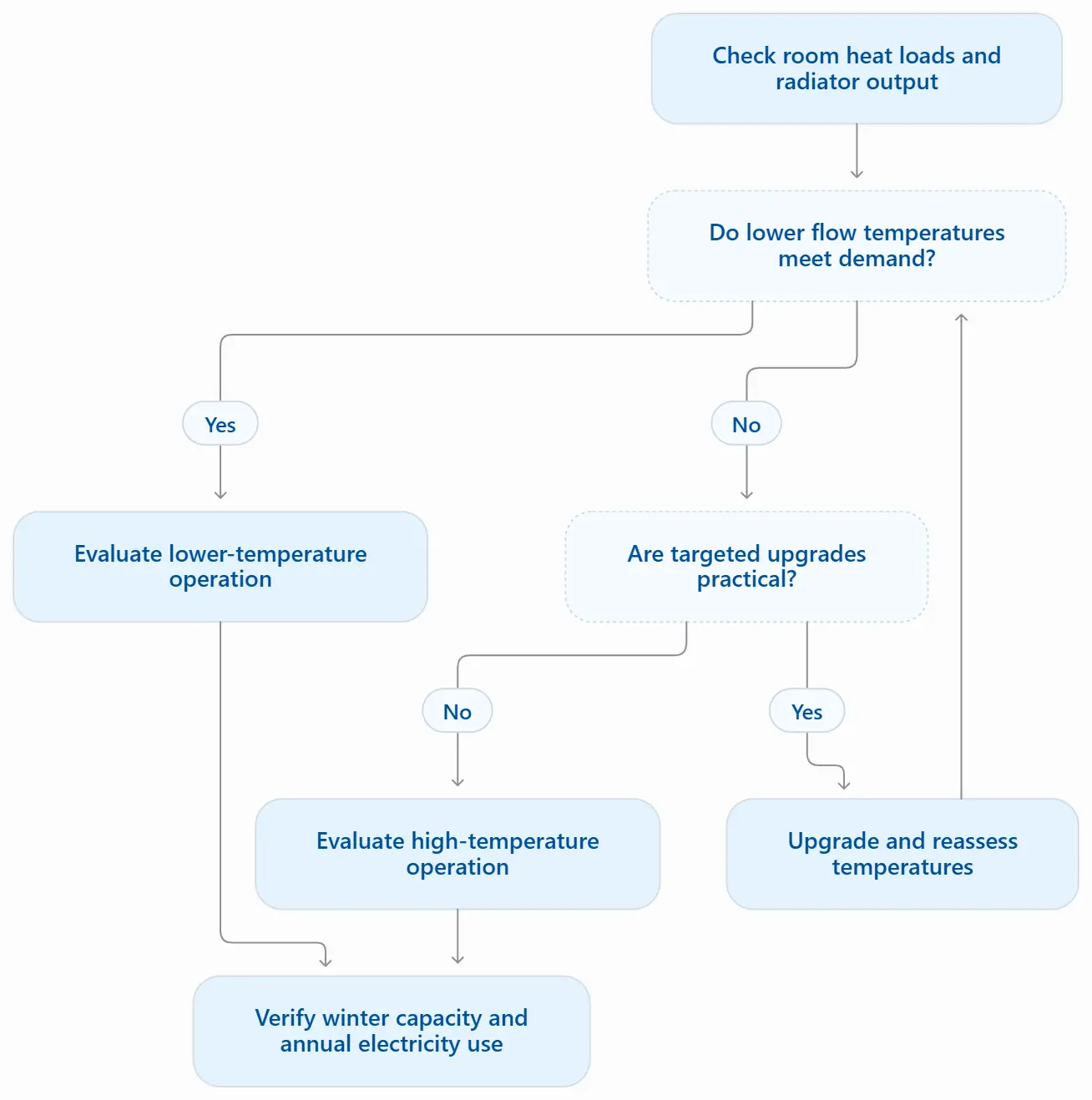
A higher-temperature design and a design with targeted radiator improvements deserve separate performance and cost calculations.
How do you check high-temperature performance during cold weather?
Check heat pump capacity and efficiency at the combination of outdoor temperature and flow temperature your building requires. A maximum water temperature alone cannot establish winter suitability, because available heating output and electricity consumption change across the permitted operating range.
The operating envelope is the manufacturer’s permitted combination of source conditions and heating-water temperatures. Request evidence that the proposed system operates within that envelope at the project’s winter design conditions.
| Check | Information to request |
|---|---|
| Heating capacity | Available output in kilowatts, or kW, at the required winter source and flow temperatures |
| Efficiency | COP at those same conditions |
| Temperature limit | Maximum permitted flow temperature at the relevant source temperature |
| Supplementary heating | When an additional heat source operates and how its electricity or fuel use enters the forecast |
Manufacturer performance tables and curves are essential because heating capacity changes with source and flow temperatures.
For air-to-water equipment, A−7/W55 denotes an outdoor-air test temperature of −7°C and heating-water outlet temperature of 55°C. This is one test point; the project’s actual design conditions determine which data are relevant.
A system can include planned supplementary heating. The annual forecast needs to account for that contribution, especially when the heat pump alone cannot meet the required output or temperature.
How much does high-temperature heat pump operation cost?
High-temperature heat pump running costs depend on annual heat demand, seasonal efficiency and the electricity tariff. Installation costs depend on the selected equipment and building work. A useful comparison calculates electricity consumption for competing designs before evaluating their total costs.
For a consistently defined system boundary:
Annual electricity consumption = annual heat delivered ÷ annual performance factor
Heat and electricity are measured in kilowatt-hours, or kWh, a unit of energy.
Hypothetical annual running-cost example
Assume annual delivered heat of 20,000 kWh and an electricity price of €0.25/kWh. These are illustrative assumptions, not an Austrian tariff quotation or a forecast for an iDM model.
| Calculation | Scenario A | Scenario B |
|---|---|---|
| Annual heat delivered | 20,000 kWh | 20,000 kWh |
| Assumed annual performance factor | 4.0 | 3.0 |
| Calculated electricity consumption | 5,000 kWh | Approximately 6,667 kWh |
| Calculated electricity cost | €1,250 | Approximately €1,667 |
Scenario B requires approximately 33% more electricity and costs approximately €417 more per year under these assumptions.
The example demonstrates the financial effect of seasonal efficiency. It does not assign either performance factor to a particular flow temperature. That relationship requires model data and a building-specific calculation.
Use the same accounting boundary for both proposals. Include supplementary heaters and relevant circulation pumps consistently; account for storage and distribution losses consistently as well.
What belongs in the investment comparison?
Compare the installed system cost alongside the cost of measures that reduce its required temperature. Relevant items include radiator changes, electrical work, hot-water equipment and any heat-source installation.
A high-temperature solution can reduce the extent of radiator replacement in a suitable building. Targeted radiator improvements can reduce future electricity consumption. Their relative value depends on the quotations, calculated temperature reduction and expected annual performance.
How can you reduce unnecessary high-temperature operation?
Reduce unnecessary high-temperature operation by matching heat pump water temperatures to actual room demand. Adjusting heating controls, correcting water distribution and improving restrictive radiators can lower the required temperature. Assess these measures before accepting continuous operation at the equipment’s maximum.
Four measures deserve particular attention:
- Set the heating curve correctly. A heating curve links outdoor temperature to the required flow temperature. Weather compensation allows lower water temperatures during milder weather while maintaining comfort.
- Balance water distribution. Hydraulic balancing adjusts water flow through heating circuits so that rooms receive their intended supply. This supports operation without raising the whole system’s temperature to compensate for poor distribution.
- Address restrictive radiators. Check the radiators in rooms that determine the highest required flow temperature. Larger suitable emitters or reduced room heat losses can remove that constraint.
- Separate space-heating and hot-water temperature requirements. Domestic hot water means water supplied to taps and showers. Its production must not unnecessarily force space heating to operate at the same elevated temperature; Fraunhofer identified this issue in monitored systems.
After commissioning, compare measured heat delivery and electricity consumption over a complete year. Record supplementary heating separately where metering permits, so its contribution to annual consumption is visible.
Which iDM heat pumps are relevant to high-temperature projects?
iDM Energiesysteme GmbH, an Austrian manufacturer, offers heat pump families for different heat sources and building scales. For high-temperature projects, select a specific model by its permitted flow temperature, available heating output and efficiency at the building’s actual operating conditions.
The product names describe overlapping aspects of system selection, including heat source, integration and building scale.
| iDM family | What it describes | Relevance to high-temperature operation |
|---|---|---|
| AERO | Heat pumps using outdoor air as their heat source | The AERO ALM 6-15 lists a maximum heating flow temperature of 70°C. Verify output and efficiency at the project’s winter conditions. |
| TERRA | Heat pumps using ground or groundwater heat | Source selection affects operating conditions. Temperature capability requires checking the individual model rather than relying on the family name. |
| iPUMP | Integrated heat pump solutions with hot-water storage in the models described here | The iPUMP A8 ONE lists a maximum heating flow temperature of 70°C. Storage-water limits are specified separately. |
| MAX | Larger heat pump systems for projects with greater heating demand | The TERRA SW MAX H series is specified for flow temperatures up to 70°C. Its name combines the TERRA source family with the MAX building-scale category. |
| NANO | Apartment-level heat pump solutions for decentralised refurbishment | The iPUMP N5 lists a maximum heating flow temperature of 70°C. Suitability depends on the apartment’s demand and the planned source system. |
These maximum temperatures support an initial shortlist. A final selection requires the current technical documentation for the exact model and configuration.
What other questions arise about high-temperature heat pumps?
High-temperature heat pump capability leaves separate questions about hot-water storage, existing boiler settings and fault messages. These distinctions matter because a permitted heating flow temperature does not automatically describe stored water temperature, necessary radiator temperature or an abnormal overheating condition.
Does 70°C heating flow mean 70°C stored hot water?
No. Heating flow temperature and stored hot-water temperature are separate specifications. For example, iDM lists 70°C maximum heating flow, 64°C maximum storage temperature, and 75°C maximum storage temperature with an electric immersion heater for the iPUMP A8 ONE. An immersion heater heats water directly using electricity.
Have the designer specify the hot-water storage, distribution and hygiene settings for the particular installation. A radiator temperature setting does not establish the correct drinking-water setting.
My boiler is set to 80°C. Does the heat pump also need 80°C?
The boiler setting alone does not establish the building’s required temperature. The relevant question is whether every room receives enough heat at lower flow and return temperatures during the design winter conditions.
Ask the installer to assess radiator output and room heat losses. A supervised lower-temperature trial during cold weather can provide supporting observations, but observations from mild weather do not establish winter design suitability.
Is high-temperature operation the same as an overheating fault?
No. High-temperature operation is an intended operating condition within the model’s permitted limits. An overheating warning concerns a condition requiring attention under the manufacturer’s instructions. Do not raise temperature limits or bypass protective controls to maintain heating.
How do you choose the right high-temperature heat pump?
Choose a heat pump that meets the building’s verified heating demand at the lowest practical flow temperature. Confirm performance during cold weather, forecast annual electricity use and compare targeted building improvements before finalising the model and its proposed operating settings.
Bring your existing heating temperatures, energy-use records and radiator information to an iDM consultation. These details help establish whether your project needs sustained high-temperature operation, occasional higher temperatures or improvements that allow a lower-temperature design.