Heat Pump Applications for Residential New Build
Heat pump applications for residential new builds include space heating, domestic hot water for taps and showers, and cooling where the equipment supports it. A heat pump is an electrically driven system that transfers heat from an environmental source, such as outdoor air, the ground or groundwater, into a building.
For a newly constructed home, the central task is coordinating the heat pump with the building before construction decisions become fixed. Equipment location, heating surfaces, hot water storage and electrical connections belong in the building design.




How does a heat pump provide heating, hot water and cooling?
A residential heat pump can supply space heating and domestic hot water, with cooling available through compatible equipment and distribution. Plan these services separately because each has different temperature, storage and control requirements, even when one unit supplies them all.
The heat pump collects environmental heat through a refrigerant, a fluid that circulates inside its refrigeration circuit. An electrically powered compressor raises the refrigerant’s pressure and temperature. A heat exchanger then transfers thermal energy to the building’s heating system.
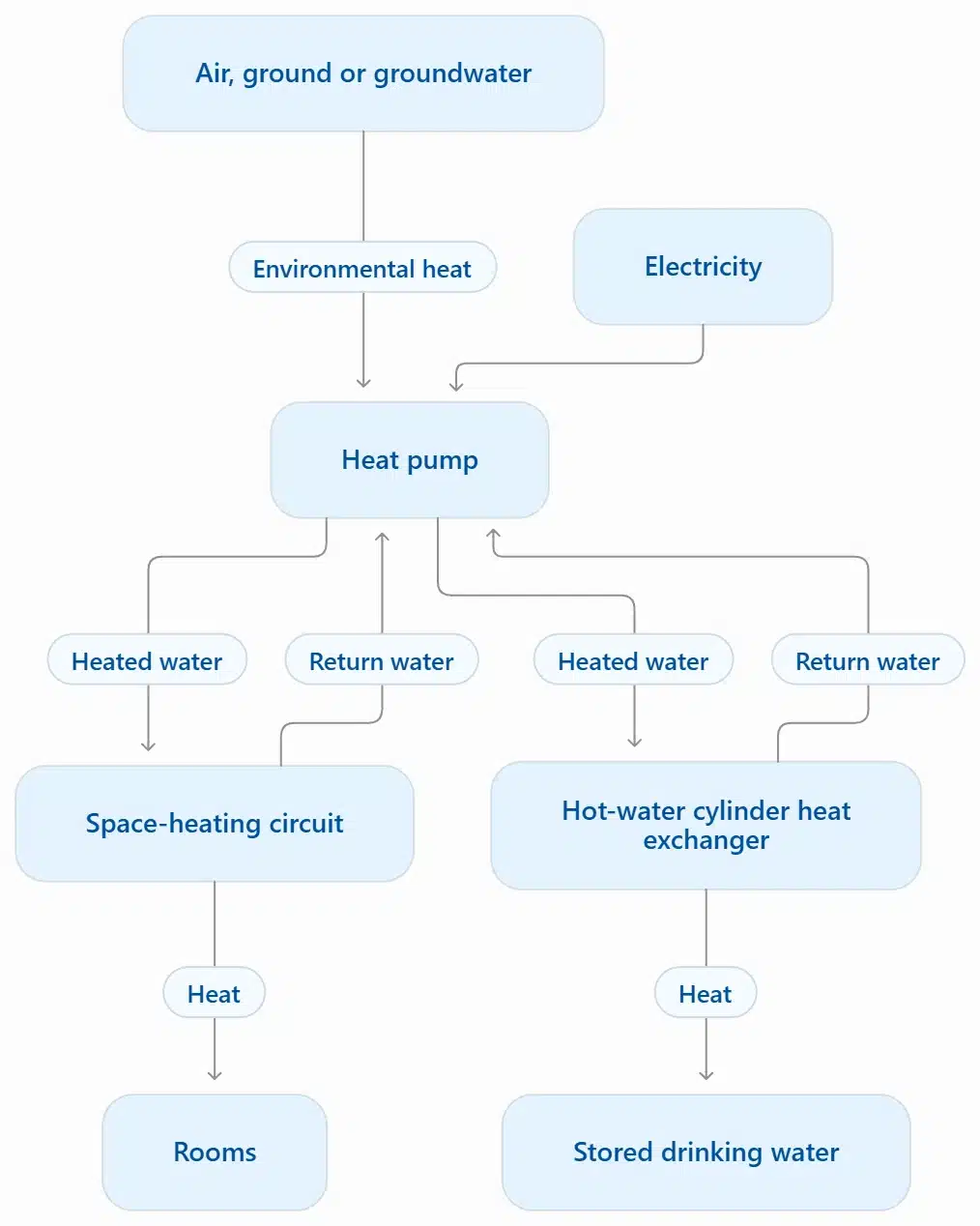
Simplified heating-mode schematic. A heat exchanger transfers heat between separate fluids: the drinking water remains separate from the heating water. Cooling requires an appropriate system configuration.
Space heating
Space heating maintains room temperatures through heat emitters: surfaces or devices that release heat into rooms. Water-based underfloor heating distributes heat through pipes beneath the floor. Appropriately sized radiators are another option. The required water temperature depends on room heat loss and emitter output.
Domestic hot water
Domestic hot water needs its own demand calculation. Storage volume and reheating capacity depend on occupancy, shower and bath use, water temperature and the timing of consumption. A home’s space-heating requirement alone does not determine its hot water needs.
During design, establish the cylinder location and pipe routes. Short, insulated distribution routes help limit heat losses. Have the designer specify the drinking-water hygiene strategy alongside storage and operating temperatures.
Summer cooling
Active cooling uses the heat pump’s compressor to remove heat from the building. Passive cooling uses a suitably cool ground or groundwater source through an appropriate system arrangement, while circulation equipment still consumes electricity. Availability depends on the selected equipment.
Surface cooling requires condensation control. The dew point is the temperature at which moisture in air starts condensing; cooled surfaces must remain above it. Confirm cooling capability and humidity-related controls before specifying floors, ceilings and room controls.
Why plan the heat pump before construction starts?
Plan the heat pump alongside the building, before foundations, service routes and floor construction are fixed. Early coordination connects the chosen heat source, equipment location and heating distribution with the construction programme, reducing avoidable redesign during installation and commissioning later.
Use the following sequence as a coordination checklist for the architect, heating designer, installer and electrician.
| Construction stage | Heat pump decision to resolve | Deliverable to request |
|---|---|---|
| Concept design | Heating requirements, possible heat sources and equipment locations | Initial heating concept and site assessment |
| Before construction drawings are finalised | Equipment space, access, pipe routes and electrical requirements | Coordinated building-services layout |
| Before groundworks | Ground collectors, drilling access or outdoor-unit foundations, as applicable | Agreed source-work and external-services plan |
| Before floors are closed | Heating pipe layout, floor construction and room controls | Approved heating-distribution design |
| Before occupation | Settings, operating checks and performance measurement | Commissioning and handover records |
The design inputs include room temperatures, the building’s insulation and windows, and ventilation losses. Establish these inputs before selecting the unit’s capacity. Austrian climate-protection initiative klimaaktiv recommends calculated sizing rather than reliance on estimates alone.
Assign responsibility for the connections between trades. For example, the outdoor-unit position affects electrical routes, heating pipes, drainage, access and sound assessment. Recording these interfaces in the construction documents gives each contractor a defined task.
Which heat source fits the building site?
The suitable heat source depends on site access, available land, ground conditions and the building’s calculated heat demand. Air, ground and groundwater systems impose different construction requirements. Compare complete installed systems, including source development, electrical work and expected operating performance.
Source development means the work needed to make environmental heat available to the heat pump. Depending on the system, this includes an outdoor air unit, buried collectors, drilled probes or groundwater wells.
| Heat source | How heat is collected | New-build planning priority | Main constraint to assess |
|---|---|---|---|
| Outdoor air | An outdoor heat exchanger collects heat from ambient air | Unit position, airflow, sound, drainage and service access | Performance changes with outdoor conditions |
| Ground | Buried horizontal pipes or probes in drilled boreholes collect ground heat | Reserve collector space or drilling access before landscaping and construction | Ground conditions and source-system design |
| Groundwater | A designed well and heat-exchanger arrangement extracts heat from groundwater | Establish source feasibility before committing to the heating concept | Water availability, quality, well design and permissions |
Ground and groundwater temperatures fluctuate less than outdoor air temperatures, but source feasibility and development work remain essential selection factors. The Energieinstitut Vorarlberg, an Austrian energy-advice organisation, identifies source temperature as a major influence on heat pump efficiency.
Groundwater systems also require assessment of the source and approval process.
For an air-source installation, assess sound at neighbouring buildings and outdoor spaces. Manufacturer sound data must be considered together with placement and the surrounding structures.
Ask the relevant local authorities to confirm applicable building and water-related requirements. For example, Vorarlberg’s permission exemptions depend on specified conditions; an exemption cannot be assumed for every Austrian project.
How are heat pump capacity and heating temperatures calculated?
Heat pump capacity follows the building’s calculated heat loss at local winter design conditions. Heating temperature follows the output required from each room’s heat emitters. Specify both together, then check the selected unit’s performance during cold weather and lighter demand.
Establish heating power separately from annual energy demand
Heating capacity is expressed in kilowatts, or kW: the rate at which the system supplies heat. Annual heat demand is expressed in kilowatt-hours, or kWh: the quantity of heat required over time. These values answer different questions.
Request a documented heat-load calculation covering the building and its rooms. The design heat load is the heating power needed to maintain specified indoor temperatures under the selected winter design conditions. Floor area alone does not establish that requirement.
The selected heat pump must be assessed at the project’s source and heating-water temperatures. Also confirm how hot water production and any supplementary heating are included in the design.
Check operation when heating demand falls
Modulation means adjusting heating output to changing demand. Compare the unit’s minimum and maximum output with the building’s needs, including milder weather. Buying additional capacity without a calculated reason can increase cost and create an unsuitable operating match.
Design the heating surfaces for low water temperatures
Flow temperature is the temperature of water supplied to the heating circuit. A lower required flow temperature reduces the temperature increase the heat pump must achieve.
For a new-build floor or wall heating system, discuss a design objective around 35°C or lower with the designer. The final temperature must follow the room calculations and floor or wall construction; it is not a universal setting.
How efficient is a heat pump, and what does it cost to run?
Heat pump running costs depend on annual heat demand, seasonal system efficiency and electricity prices. Compare performance under matching conditions, then calculate consumption using a clearly defined system boundary. A product’s laboratory efficiency rating does not establish your future bill.
Understand the performance figures
Three terms describe different aspects of efficiency.
| Measure | Meaning | Appropriate use |
|---|---|---|
| COP: coefficient of performance | Heat output divided by electrical input at a specified operating point | Comparing equipment at matching test conditions |
| SCOP: seasonal coefficient of performance | Seasonal performance calculated using standardised conditions | Comparing products for the same climate and temperature application |
| SPF: seasonal performance factor; annual values are commonly called JAZ in German | Heat supplied divided by electricity consumed over the assessment period, within a defined boundary | Estimating or measuring the performance of the installed system |
A predicted annual performance figure remains an estimate until operating data are available. The German Heat Pump Association distinguishes standardised product comparisons from performance specific to a building.
Calculate an illustrative electricity budget
The basic relationship is:
Annual electricity consumption = annual heat output ÷ annual SPF
For this hypothetical example, assume annual system heat output of 10,000 kWh and an electricity price of €0.30/kWh. Neither input represents an iDM quotation or a current Austrian tariff.
| Assumed annual SPF | Calculated electricity consumption | Calculated annual electricity cost |
|---|---|---|
| 3.0 | Approximately 3,333 kWh | Approximately €1,000 |
| 4.0 | 2,500 kWh | €750 |
The €250 difference illustrates the effect of efficiency while keeping heat output and electricity price constant. It does not predict savings for a particular home.
For a project calculation, define whether the electricity total includes circulation pumps, source pumps, controls and electrical backup. Include heat losses consistently. Add any fixed tariff charges, maintenance and costs outside that measurement boundary separately.
Compare complete installation quotations
A reliable installed price requires a site-specific quotation. Request an itemised scope covering:
- Heat pump equipment, controls and hot water storage.
- Source development, outdoor foundations and associated site work.
- Heating distribution, plumbing and electrical installation.
- Design, commissioning, documentation and agreed aftercare.
Compare quotations against the same heat-load calculation and service requirements. A lower equipment price does not establish a lower total project cost.
Can rooftop solar electricity contribute?
Photovoltaics, abbreviated PV, convert sunlight into electricity. A PV system can supply part of the heat pump’s demand when generation and consumption coincide. Plan the electrical and control interfaces during construction.
Rooftop PV does not establish year-round heating independence. Winter heating demand and solar generation have different seasonal patterns, so the expected contribution requires a project calculation.
Which iDM heat pump ranges are relevant to new-build planning?
iDM heat pump ranges describe different selection dimensions: heat source, integrated storage and project scale. Start with the building design, then shortlist suitable models. A family name alone does not establish capacity, cooling capability, installation requirements or suitability for construction.
iDM Energiesysteme GmbH is an Austrian heat pump manufacturer. Its product families identify different aspects of a heating solution; they are not five interchangeable heat-source categories.
| iDM range | What the name identifies | Relevance to a residential new build |
|---|---|---|
| AERO | Air-source heat pumps | Investigate where outdoor air is the selected source and a suitable installation location is available. |
| TERRA | Ground-source and groundwater heat pump solutions | Investigate after confirming that the site supports the required source installation. |
| iPUMP | Residential heat pump solutions with integrated hot water storage in the relevant models | Investigate when equipment footprint and integrated storage are important design criteria. |
| MAX | Larger-capacity heat pump solutions | Investigate for residential projects whose calculated demand requires larger equipment. |
| NANO | Apartment-level heat pump solutions, including iPUMP N5 | iDM currently positions iPUMP N5 around apartment renovation. Any new-build application needs explicit project-specific confirmation. |
As a concrete product example, iDM lists the iPUMP A ONE with a 320-litre integrated hot water tank. That specification describes the product; the appropriate storage volume for your project still requires a demand assessment.
Before selection, confirm the exact model’s output at design conditions, storage arrangement, cooling options, installation dimensions and availability in the project’s country.
What must be checked before the heat pump is handed over?
Heat pump commissioning confirms that the installed system matches its design and operates correctly. Before handover, obtain recorded settings, balancing results, operating instructions and a measurement plan. These records give homeowners and facility managers a practical baseline for checking performance.
Commissioning includes checking the completed installation and setting it up for operation. Request a handover package covering these four areas:
- Heating distribution: record hydraulic balancing, the adjustment of water flows so that heating circuits receive their designed supply.
- Controls: document the heating curve, which relates outdoor temperature to required heating-water temperature, alongside hot water and cooling settings.
- Measurement: identify heat and electricity meters, what each meter includes, and the starting readings.
- Operation and service: provide operating instructions, maintenance requirements, service contacts and the completed commissioning record.
Klimaaktiv’s installation guidance includes hydraulic balancing, acceptance documentation and instructions for assessing annual performance.
Agree a review after the system has operated through heating weather. Use room comfort, settings and meter readings to assess whether the installed system is meeting its design objectives.
What else do homeowners ask about new-build heat pumps?
A heat pump does not automatically require a buffer tank or a second boiler. Ventilation remains a separate building service unless explicitly integrated. Funding eligibility depends on the programme. Confirm these details during design so optional equipment becomes a decision.
Does every heat pump need a buffer tank?
No. A buffer tank stores heating-system water, while a domestic hot water cylinder serves the drinking-water supply. Buffer requirements depend on the hydraulic arrangement and equipment requirements. Have the designer explain its purpose in the proposed installation.
Can a new build use radiators with a heat pump?
Yes, provided the radiators deliver the required room output at the planned water temperature. Underfloor heating is one suitable distribution option, but the calculation determines whether a proposed emitter system works.
Does the heat pump also ventilate the home?
A heating heat pump does not inherently provide fresh air. Ventilation exchanges indoor and outdoor air and requires its own design. Combined ventilation, heating and hot water equipment exists, but that integration must be specified explicitly.
Is a second boiler necessary?
A second boiler is not an inherent requirement of a new-build heat pump installation. Ask the designer to document how the system meets winter design demand and whether electrical backup or another supplementary heat source forms part of the selected concept.
Can new-build projects receive heat pump funding?
Check the current programme specifically for new construction before including funding in the budget. Confirm eligible applicants, eligible equipment, application timing and any approval required before ordering. A programme supporting replacement of an existing heating system does not, by itself, establish eligibility for a new home.
How do you start planning your new-build heat pump?
Start your heat pump selection with the building plans, site location, calculated heating requirement and expected hot water use. These inputs help turn a product enquiry into a project discussion and identify which installation details still need professional design work.
Bring the planned construction schedule and any cooling or PV requirements to the consultation. The useful outcome is a coordinated system proposal with a defined installation scope.
For a single- or two-family new-build project, use the iDM configurator to begin exploring a suitable system. iDM identifies this as the configurator’s intended scope.