Heat Pump Applications in Residential Renovation
Heat pump applications in residential renovation include replacing boiler-based space heating, upgrading domestic hot water production and adding cooling where the equipment and distribution system support it. A heat pump uses electricity to transfer environmental heat from air, ground or water into a building. Domestic hot water means the heated drinking water supplied to taps, showers and baths.
The main renovation decision is how to integrate the heat pump with what you retain, what you improve and when the work happens. Existing radiators, planned insulation and the timing of boiler replacement all influence the final system.




What can a heat pump replace during a residential renovation?
A heat pump can replace a boiler for space heating and domestic hot water, provided the existing system is assessed and adapted. Renovation also creates opportunities to reduce heating temperatures, improve controls and add cooling through compatible equipment where appropriate.
The following applications involve different amounts of work:
| Renovation application | What changes | What needs assessment |
|---|---|---|
| Replace an oil or gas boiler | A heat pump becomes the main heat generator | Required heating output, radiator performance, pipework and electrical supply |
| Coordinate heating with insulation or window replacement | Equipment and settings are matched to the improved building | Heating requirements before and after the improvements |
| Upgrade domestic hot water production | The heat pump supplies a compatible hot water system | Storage capacity, reheating performance and drinking-water hygiene |
| Add summer cooling during refurbishment | Suitable equipment removes heat from rooms | Cooling capability, compatible surfaces or terminals, and condensation control |
iDM offers heat pump solutions for heating, hot water and suitable cooling applications in renovation projects. The selected model and installation design determine which functions are available.
Replacing the heat generator does not automatically require replacing every radiator. Equally, retaining the existing distribution system requires a technical assessment rather than an assumption that its previous boiler settings remain appropriate.
How do you coordinate a heat pump with insulation and window upgrades?
Coordinate the heat pump with the home’s planned insulation and window improvements by calculating heating requirements before and after renovation. The installation sequence must cover immediate comfort needs while avoiding equipment that becomes unnecessarily large once those improvements are complete.
The design heat load is the heating power required to maintain specified indoor temperatures under the location’s winter design conditions. It is measured in kilowatts, abbreviated kW. Insulation improvements can reduce this requirement, changing the appropriate heat pump capacity. Oversizing can cause excessive cycling: repeated stopping and starting when demand is below the unit’s minimum output.
Ask the designer to document two conditions when work is phased: the building at heat pump installation and the building after the committed improvements.
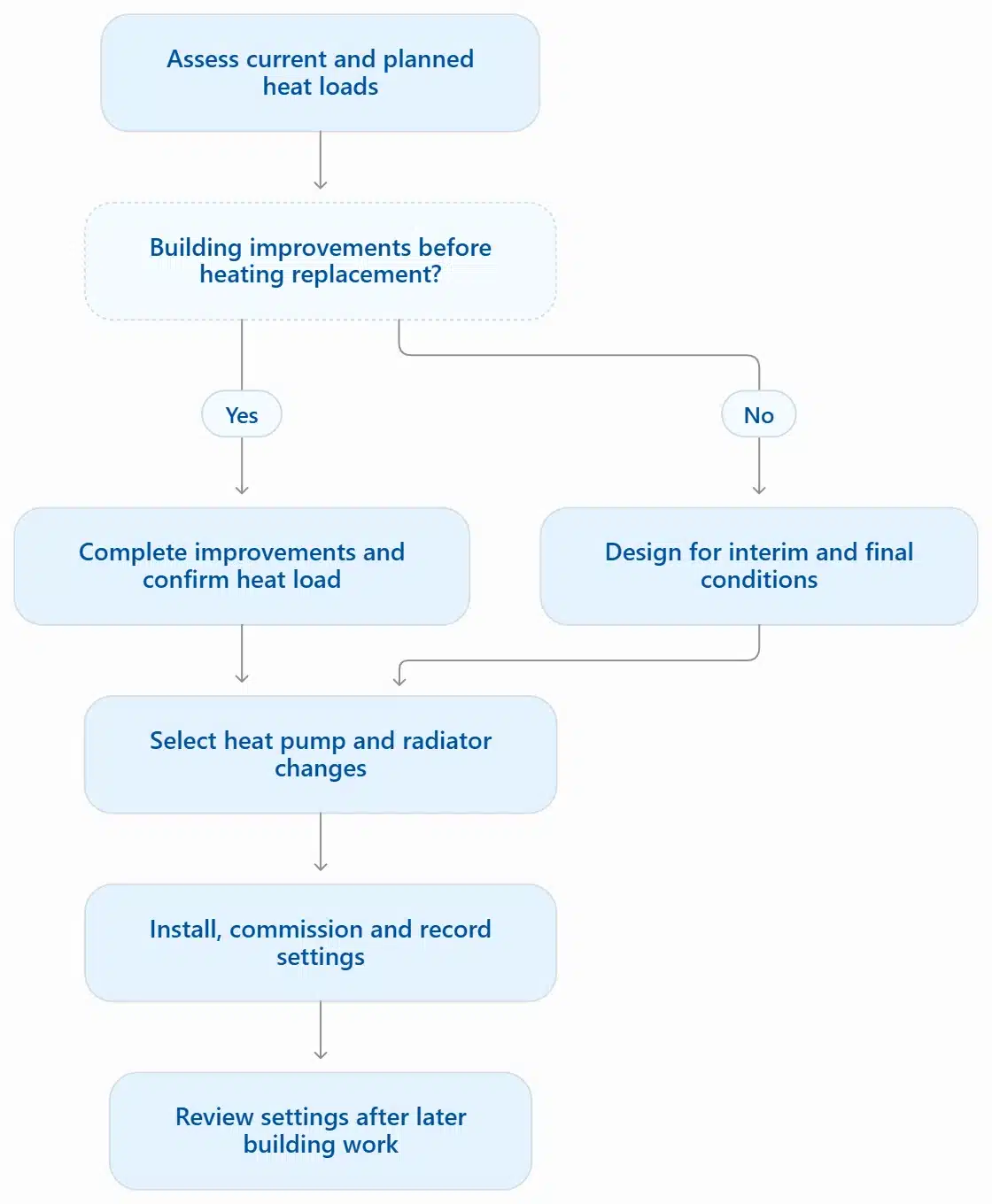
Renovation sequence: establish both present and future heating requirements before selecting equipment.
When building improvements come first
Confirm the completed insulation, windows and heated areas before finalising equipment capacity. Check radiator output against the reduced room heat losses. Existing radiators can become suitable for lower water temperatures after heat loss falls.
When the boiler needs replacing first
Request an explicit interim operating plan. It must explain how the system will meet demand before the building improvements and operate after demand falls. Check both maximum heating output and minimum adjustable output.
Hypothetical example: A calculation gives a current design heat load of 10 kW and a future load of 6 kW after specified improvements. Selecting equipment solely for 6 kW leaves the interim heating requirement unresolved. Selecting equipment solely for 10 kW leaves its operation after renovation unexamined.
Treat that example as a planning principle, not a sizing recommendation for another property.
Can you keep the existing radiators and pipework?
Existing radiators and pipework can remain when they deliver the required room heat at suitable water temperatures and flow rates. A heat pump assessment therefore checks each room and the distribution system before specifying replacements or committing to underfloor heating.
Flow temperature is the temperature of water supplied to the heating circuit. Lower required flow temperatures improve heat pump operating conditions because the system has less temperature increase to achieve.
Austria’s climate-protection initiative klimaaktiv uses adequate room heating at a maximum flow temperature of 55°C on a cold winter day as a practical indicator of suitability. This is an initial check; equipment sizing and installation feasibility still require assessment.
Energieagentur Tirol, a regional energy-advice organisation, recommends flow temperatures no higher than 50°C for efficient operation. These recommendations serve different purposes: one offers an initial suitability indicator, while the other encourages a lower operating temperature. Neither makes 55°C an efficiency guarantee or a universal technical limit.
Find the room that sets the temperature requirement
One room with insufficient radiator output can force the entire heating circuit to operate at a higher temperature. Targeted radiator replacement or improvements to that room’s insulation can therefore benefit the whole circuit. Energieinstitut Vorarlberg, an Austrian energy-advice organisation, identifies this room-level constraint in renovation planning.
Check water circulation as well as radiator size
Hydraulic balancing adjusts water distribution so each heating circuit receives its calculated flow. The installer also needs to assess pipe sizes, valves and pump requirements for the proposed operating conditions. A system that worked with a boiler does not automatically provide the required flow for a heat pump.
An installer-supervised temperature trial can support the assessment. Keep space-heating adjustments separate from hot water hygiene settings.
What site checks determine the heat pump system?
Heat pump selection depends on the available heat source, installation space, electrical supply and local permissions. For renovation, the survey must also establish access through existing buildings, workable pipe routes and the effect of outdoor equipment on neighbours and residents.
The heat source is where the heat pump collects environmental energy. Its availability determines the associated construction work.
| Heat source | How heat is collected | Renovation checks |
|---|---|---|
| Outdoor air | An air-source unit extracts heat from outside air | Equipment position, sound, airflow, drainage and service access |
| Ground | Buried collectors or probes in boreholes collect ground heat | Available land, drilling or excavation access, ground conditions and permissions |
| Groundwater | A designed well arrangement supplies water to a heat exchanger | Water availability, water quality, well feasibility and permissions |
Site conditions can rule out a source before equipment selection begins. Energieagentur Tirol highlights sound considerations for air-source systems, ground suitability for geothermal systems and groundwater availability and quality for water-source systems.
Ask an electrician to assess the existing connection and distribution board. Include access dimensions for indoor equipment and storage tanks in the survey; a suitable floor area does not establish that equipment can pass through the available doors and stairs.
Confirm applicable requirements with the local authority and electricity network operator before ordering. Austrian installation exemptions can depend on specific conditions; they cannot be assumed to apply throughout Austria, Germany and Switzerland.
How does hot water fit into the renovation?
Domestic hot water requires its own renovation assessment because showering and bathing demand does not fall automatically when insulation improves. A heat pump system needs compatible storage, adequate reheating capacity and a documented hygiene strategy alongside its space heating design.
A retained hot water cylinder needs more than sufficient volume. Its heat exchanger, the component transferring heat between separate fluids, must provide adequate heating performance at the proposed temperatures. Confirm compatibility using the cylinder and heat pump documentation.
Hot water demand depends on occupancy, bathing habits and the timing of use. Discuss expected demand before choosing storage capacity; an oversized cylinder increases stored-water volume and heat losses, while insufficient capacity compromises comfort.
The designer must specify drinking-water hygiene, operating temperatures and any circulation arrangement together. Lowering space-heating temperatures does not establish an appropriate hot water setting. Insulating retained hot water pipes and storage also forms part of the renovation assessment.
How efficient can a heat pump be after renovation?
Heat pump efficiency depends on operating temperatures, equipment sizing and installation quality. Renovation improves the opportunity for efficient operation when it reduces heat loss or heating temperatures. Measured seasonal performance provides more useful evidence than a single laboratory efficiency figure.
Three measures answer different questions:
| Measure | Definition | What it tells you |
|---|---|---|
| COP — coefficient of performance | Heat output divided by electrical input at specified operating conditions | Equipment performance at that operating point |
| SCOP — seasonal coefficient of performance | Seasonal performance calculated under standardised conditions | A basis for comparing products under matching assumptions |
| SPF — seasonal performance factor | Heat supplied divided by electricity consumed over the assessment period, within a defined measurement boundary | Performance of the installed system; an annual value is commonly called JAZ in German |
A product’s COP or SCOP does not establish the annual efficiency of your installation. klimaaktiv distinguishes these comparison values from the annual performance calculated or measured for a particular system.
What does measured evidence show?
The Fraunhofer Institute for Solar Energy Systems ISE, a German applied-research institute, monitored 77 heat pump systems in existing homes. Its principal 2024 evaluation included the following results:
| Systems evaluated in 2024 | Number evaluated | Measured SPF range |
|---|---|---|
| Air-source heat pumps | 49 | 2.6–4.9 |
| Ground-source heat pumps using geothermal probes | 13 | 3.6–5.4 |
These figures come from a German field study covering buildings with different renovation conditions. They are not iDM-specific results or predictions for an individual Austrian property. The research also identified opportunities to improve sizing and system operation.
Request a project-specific seasonal performance estimate, including its assumptions about heating temperatures, hot water and supplementary electricity use.
How do you estimate renovation costs and electricity use?
Heat pump renovation costs combine equipment with the work needed to adapt the property. Electricity costs depend on annual heat demand, seasonal efficiency and electricity tariffs. Compare quotations against the same renovation scope, with assumptions and exclusions stated in writing.
Compare complete installation scopes
Request an itemised quotation covering:
- Heat pump equipment, controls and hot water provision.
- Source installation, foundations, drilling or excavation where applicable.
- Radiator, pipework and electrical adaptations.
- Removal of redundant equipment, commissioning, documentation and aftercare.
Separate insulation and window costs from heating-system costs, while recording how those improvements affect equipment selection. Confirm current funding conditions and application timing before making commitments.
Calculate an illustrative electricity budget
A kilowatt-hour, abbreviated kWh, measures energy consumed or supplied over time.
The calculation is:
Annual electricity consumption = annual heat supplied ÷ annual SPF
For this hypothetical example, assume 18,000 kWh of annual heat supplied and an electricity price of €0.30/kWh. These are illustrative inputs, not a current Austrian tariff or an iDM quotation.
| Assumed annual SPF | Calculated electricity consumption | Calculated electricity cost |
|---|---|---|
| 3.0 | 6,000 kWh/year | €1,800/year |
| 4.0 | 4,500 kWh/year | €1,350/year |
The calculated difference is €450 per year at unchanged heat demand and electricity price. It demonstrates the effect of efficiency; it does not predict savings against your current boiler.
Keep the calculation boundary consistent. State whether the estimate includes controls, circulation pumps, source equipment and electric backup. Add maintenance, fixed charges and costs outside that boundary separately.
Fuel bills also need interpretation: purchased boiler fuel and useful heat delivered are different quantities. A payback calculation requires a comparable baseline, a complete investment figure and explicit energy-price assumptions.
Which iDM heat pump ranges fit renovation projects?
iDM heat pump ranges address different renovation requirements, including heat source, integrated hot water storage and system scale. Select the renovation strategy first, then assess suitable models against calculated demand, required temperatures, available space and the planned sequence of improvements.
iDM Energiesysteme GmbH is an Austrian heat pump manufacturer. Its product names describe different aspects of a system, so they are not five interchangeable heat-source categories.
| iDM range | What the range identifies | Relevance to renovation |
|---|---|---|
| AERO | Air-source heat pumps | Investigate when outdoor air is the selected source and a suitable installation position is available. |
| TERRA | Heat pumps using ground or groundwater | Investigate when the property supports the necessary source installation. |
| iPUMP | Heat pump solutions with integrated hot water storage in the relevant models | Assess when equipment layout and combined heating and hot water provision are priorities. |
| MAX | Heat pump solutions for larger heating requirements | Assess for residential renovation projects whose calculated demand requires larger equipment. |
| NANO | Apartment-level heat pump solutions, including the iPUMP N5 | Assess for coordinated, dwelling-by-dwelling heating refurbishment with a designed heat-source arrangement. |
NANO illustrates a specific renovation pathway: individual dwellings can be upgraded within a coordinated building concept. Its source arrangements require project planning; the product name alone does not establish a complete replacement for an existing apartment boiler.
For every range, confirm the exact model’s output at the project’s winter conditions, minimum output, temperature capability and installation requirements. A maximum temperature rating alone does not establish seasonal efficiency.
How is a heat pump renovation installed and checked?
A heat pump renovation is complete when the installed system delivers the agreed comfort and its operation is documented. Coordinate building work, equipment replacement and commissioning, then review performance during heating weather and adjust settings after later insulation improvements occur.
Agree the following sequence with the responsible contractors:
- Confirm the design. Record calculated loads, retained equipment, planned adaptations and the agreed renovation stages.
- Prepare the property. Coordinate source works, equipment access, electrical work and pipe routes.
- Manage the changeover. Agree heating and hot water interruptions, resident access and any temporary provision.
- Commission the system. Complete hydraulic balancing and set the controls, hot water operation and supplementary heating strategy.
- Handover and review. Obtain the system diagram, settings, operating instructions and a plan for reviewing performance.
klimaaktiv’s installation guide follows this progression from requirements and quotations through execution, acceptance and commissioning.
The heating curve is the control relationship that adjusts heating-water temperature according to outdoor conditions. Ask the installer to explain its settings and how they will be reviewed after building improvements. Heat and electricity measurements provide the basis for checking actual efficiency; room comfort and backup-heater operation also need attention.
What else do homeowners ask about heat pump renovation?
Heat pump renovation questions extend beyond equipment selection to disruption, backup heating, solar electricity and summer comfort. These decisions depend on the existing installation and the agreed renovation scope, so include them in the design brief before accepting a quotation.
Must the existing boiler always be removed?
A heat pump can operate alongside another heat generator in a deliberately designed hybrid system. Keeping a boiler adds equipment and control responsibilities. Request a clear explanation of its intended operating role, running costs and eventual removal where replacement is phased.
Can occupants remain at home during installation?
Remaining at home depends on the extent and sequence of the work. Request a project-specific programme identifying service interruptions, access restrictions and temporary heating or hot water arrangements. A boiler replacement and a refurbishment involving floors or extensive pipework have different disruption profiles.
Can rooftop solar electricity help power the heat pump?
Photovoltaics, abbreviated PV, convert sunlight into electricity that can supply the heat pump when generation and consumption coincide. Winter solar production is lower than summer production, so rooftop PV does not establish year-round heating independence. Assess the contribution using the proposed system and consumption pattern.
Will keeping radiators also provide summer cooling?
Retaining radiators for heating does not establish useful cooling performance. Cooling needs compatible equipment and suitable room terminals or surfaces. Condensation control is essential: the dew point is the temperature at which moisture in the air begins condensing. Have the designer assess cooling separately before including it in the renovation scope.
How can you start planning your heat pump renovation?
Start your heat pump renovation with information about the existing heating system, recent energy use and planned building improvements. These details help establish a suitable system concept and identify necessary upgrades before you request a detailed design and installation quotation.
Bring your available building plans, energy certificate, consumption records and renovation schedule to the consultation. Include photographs or dimensions of radiators, the equipment space and possible outdoor locations.
The next step is to establish what the building needs at installation and after renovation, then select the matching heat pump system with iDM and your installation partner.