Heat Pump Applications in Residential Old Buildings
Heat pumps can provide space heating and domestic hot water in older residential buildings, including homes with existing radiators. Suitability depends on the building’s heat losses, required heating-water temperature and installation conditions. Building age alone does not determine whether a heat pump will work efficiently.
A heat pump is an electrically powered heating system that transfers energy from outdoor air, the ground or groundwater into usable heat. Domestic hot water means heated drinking water for taps, baths and showers. A suitable system can replace an existing boiler while retaining compatible heating components.
For an older home, the starting point is its present condition: the walls, roof, windows, radiators and available equipment space. This guide explains how those existing features affect suitability and which findings deserve closer investigation before choosing equipment.




Can a heat pump work in an old residential building?
A heat pump can heat an old residential building when its output matches the building’s heat losses and the heating system delivers sufficient warmth at suitable water temperatures. Construction date alone does not establish efficiency, comfort or the necessary upgrades.
Measured results demonstrate that older buildings can support efficient heat pump operation. Fraunhofer ISE, Germany’s Fraunhofer Institute for Solar Energy Systems, monitored 77 heat pump installations in houses containing one to three dwellings. The properties included buildings dating back to 1826, with conditions ranging from unrefurbished to comprehensively improved.
The annual seasonal performance factor, or SPF, measures heat supplied divided by electricity consumed over a year within a defined measurement boundary. German-language guidance calls this annual value Jahresarbeitszahl, abbreviated JAZ.
The study’s main 2024 evaluation reported:
| Heat source | Systems evaluated in 2024 | Measured annual SPF | Reported average |
|---|---|---|---|
| Outdoor air | 49 | 2.6–4.9 | 3.4 |
| Ground, using borehole probes | 13 | 3.6–5.4 | Not stated in the project summary |
An SPF of 3.4 represents 3.4 units of heat supplied per unit of electricity within the study’s measurement boundary. Researchers found no relationship between building age and annual efficiency in this sample. These German field results demonstrate feasibility; they do not predict the performance of a particular Austrian home.
Which building characteristics determine heat pump suitability?
Heat pump suitability depends on the building’s heat losses, the output of existing radiators, the condition of heating pipes and the available installation space. Assess these characteristics together, because improving one component does not automatically resolve limitations in another component.
The design heat load is the heating power needed to maintain specified indoor temperatures under local winter design conditions. It is expressed in kilowatts, or kW. Annual heat demand is an energy quantity expressed in kilowatt-hours, or kWh. A building needs both assessments: power for equipment sizing and annual energy for consumption estimates.
Use the following assessment to identify the building’s limiting conditions.
| Existing characteristic | What to establish | Why it matters |
|---|---|---|
| Building fabric: walls, roof, windows and floors | Heat losses from individual rooms, including ventilation losses | Determines how much heating each room needs |
| Radiators: devices that release heat from hot water into rooms | Available output at the proposed water temperatures | Determines whether existing radiators can maintain comfort |
| Heating distribution: pipes, valves and circulation equipment | Condition and ability to deliver the required water flows | Establishes which components can remain |
| Installation space | Equipment access, indoor dimensions and a feasible heat-source location | Establishes whether the proposed system physically fits |
A room-by-room assessment is especially useful where improvements have been uneven. New windows in the living room do not establish the heating requirement of an unchanged bathroom or an exposed room beneath the roof.
Ask the designer to check heat pump output at the project’s actual winter conditions. Also check the equipment’s minimum output during milder weather: excessive capacity can cause repeated starting and stopping.
Can existing radiators provide enough heat?
Existing radiators can work with a heat pump when they deliver each room’s required heating output at the selected flow temperature, meaning the temperature of water entering the heating circuit. Check individual rooms before deciding which radiators need replacing first.
Radiator output depends on its dimensions, construction and operating temperatures. A radiator previously supplied with hotter boiler water may still provide sufficient heat at a lower temperature, particularly where the room’s heat losses have already been reduced.
Klimaaktiv, Austria’s federal climate and energy-transition initiative, confirms that modern heat pumps can work with radiators. Its guidance identifies larger radiators and suitable radiator fans as ways to increase heat delivery at lower water temperatures.
Is 55°C a universal suitability limit?
No. A flow temperature of 55°C is a useful assessment reference, not a universal boundary between working and non-working systems.
Energieagentur Tirol, a regional Austrian energy-advice organisation, recommends keeping flow temperatures at or below 50°C for efficient operation. Klimaaktiv discusses modern heat pump operation with radiators at temperatures up to 55°C. Both support the same direction: reduce the temperature required to keep rooms comfortable.
A requirement above 55°C calls for closer assessment of radiator improvements, heat losses and the selected heat pump’s performance. A product’s maximum temperature does not establish its annual electricity consumption.
How do you identify the room that limits the system?
Compare each room’s calculated heating requirement with its radiator output at the proposed operating temperatures. Energieinstitut Vorarlberg, an Austrian energy-advice organisation, notes that replacing the radiator in the most demanding room can sometimes allow lower temperatures throughout the system.
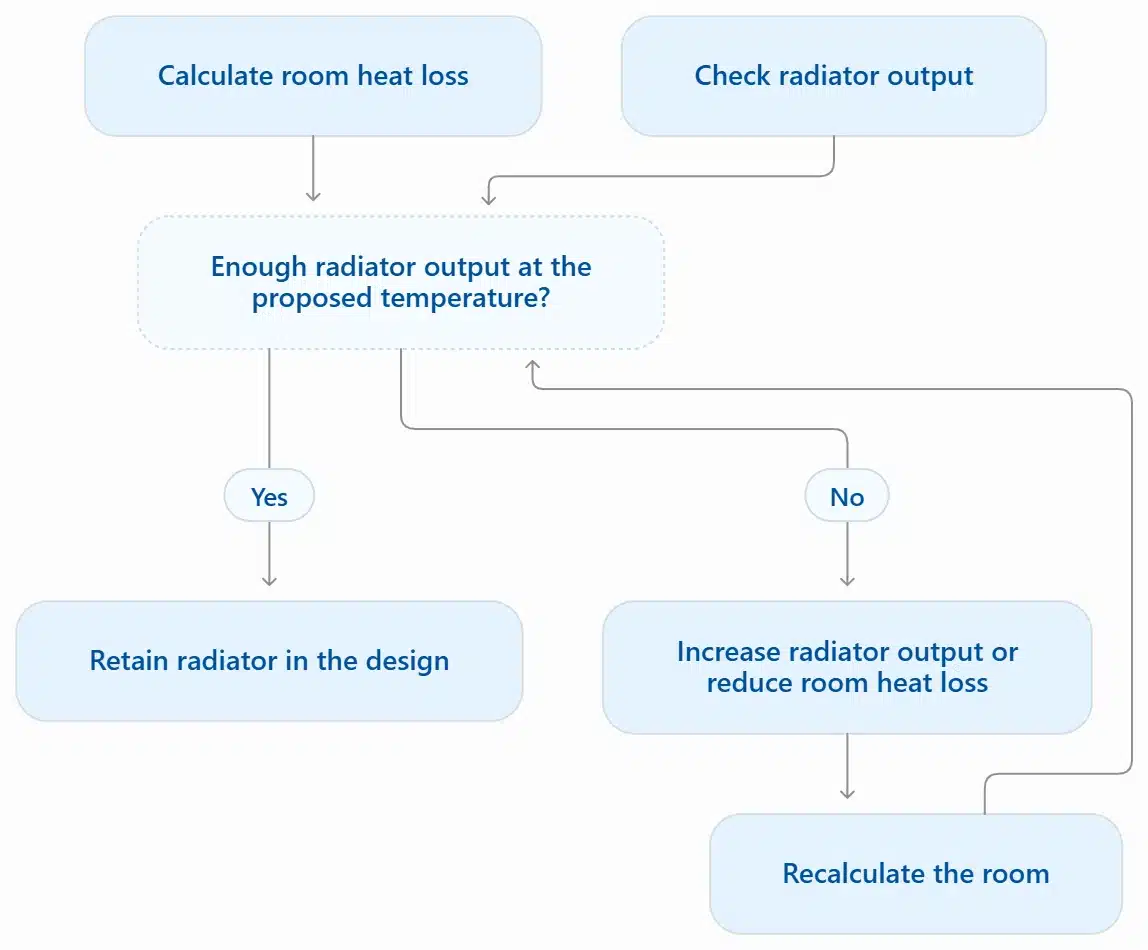
Radiator suitability is checked room by room. Heat pump capacity, pipework and site feasibility require separate assessment.
For a hypothetical example, a room needs 1.5 kW at winter design conditions, while its radiator supplies 1.0 kW at the proposed temperatures. The 0.5 kW shortfall requires a larger or different heat emitter, reduced room heat loss, or a revised operating temperature. This calculation identifies a specific limitation without assuming every radiator needs replacement.
Can existing settings exaggerate the temperature requirement?
Yes. Poor water distribution or an unnecessarily high control setting can obscure what the building actually needs.
Hydraulic balancing means adjusting water flows so each heating circuit receives its designed supply. Have the installer assess this alongside the heating curve, the control relationship between outdoor temperature and heating-water temperature. A supervised temperature trial can provide useful observations, but a mild-weather test does not prove performance at winter design conditions.
Does an old building need insulation before a heat pump?
An old building does not automatically need complete insulation before a heat pump installation. Insulation reduces heat loss, but the necessary improvements depend on existing room requirements and radiator output. Targeted measures can improve suitability without requiring comprehensive building refurbishment.
Fraunhofer ISE’s field research supports efficient heat pump operation in older buildings without requiring every property to reach new-build energy performance. That finding does not mean insulation has no value; it means suitability requires assessment of the actual building.
The building envelope is the collection of walls, roof, windows and floors separating heated rooms from colder surroundings. Improving an envelope component reduces heat loss through that component.
The most useful improvement for heat pump operation may be the measure that addresses a limiting room. Reducing total building demand does not necessarily lower the temperature needed by an unchanged room with an undersized radiator. Energieinstitut Vorarlberg highlights this issue in partially refurbished buildings.
For the suitability assessment, request two clearly separated results:
- The calculated heating requirement in the building’s current condition.
- The calculated requirement after any improvements already planned.
Those results show how planned work changes equipment requirements. Detailed construction sequencing belongs in the renovation project plan.
Which heat source fits an older property?
The appropriate heat pump source depends on access to outdoor air, suitable ground or usable groundwater at the property. Existing gardens, neighbouring homes, drilling access and equipment space influence feasibility. Compare source options alongside the building’s required heating water temperature.
The heat source supplies the environmental energy collected by the heat pump. Existing site conditions can make one source more practical than another.
| Heat source | How heat is collected | Particular checks for an older property |
|---|---|---|
| Outdoor air | An air-source heat pump extracts energy from surrounding air | Outdoor-unit location, airflow, sound, drainage and service access |
| Ground | Buried collector pipes or probes installed in drilled boreholes collect ground heat | Excavation or drilling access, underground services and ground suitability |
| Groundwater | A well arrangement supplies groundwater for heat extraction | Water availability, quality, well feasibility and applicable permissions |
Energieagentur Tirol identifies ground conditions, groundwater availability and sound in densely built areas as material source-selection constraints. A small garden alone does not establish whether ground-source heating is feasible; the available source arrangement needs investigation.
What changes in cold weather?
Air-source heat pumps face colder source temperatures as outdoor conditions cool. The designer must check available heating output and efficiency at the location’s winter conditions, including the energy required for defrosting when frost forms on the outdoor heat exchanger.
For Austrian projects, confirm applicable building, sound and water-related requirements with the relevant authorities. For a heritage-listed property, discuss equipment visibility and alterations to historic fabric before finalising the installation position. Avoid assuming that one approval arrangement applies across Austria, Germany and Switzerland.
How much electricity will a heat pump use in an old building?
A heat pump’s annual electricity demand depends on the heat it supplies and its annual system efficiency. An older home with higher heat losses requires more heat. Lowering those losses and improving efficiency address separate parts of the consumption calculation.
The basic relationship is:
Annual electricity consumption = annual heat supplied ÷ annual SPF
Keep the calculation boundary consistent. A figure covering space heating and domestic hot water needs an SPF covering those same services. Identify whether the electricity total includes source pumps, controls, circulation equipment and electric supplementary heating.
A coefficient of performance, or COP, describes efficiency at a specified operating point. It cannot replace a site-specific annual performance estimate. Klimaaktiv recommends documenting the expected annual performance and providing heat and electricity measurement for checking operation.
What does efficiency change in a consumption estimate?
The following hypothetical calculation assumes 24,000 kWh of annual heat supplied and an electricity price of €0.30/kWh. These are illustrative inputs, not an Austrian tariff quotation or a prediction for your property.
| Assumed annual SPF | Calculated annual electricity use | Calculated electricity cost |
|---|---|---|
| 2.5 | 9,600 kWh | €2,880 |
| 3.5 | Approximately 6,857 kWh | Approximately €2,057 |
| 4.5 | Approximately 5,333 kWh | Approximately €1,600 |
The scenarios hold heat demand constant to isolate the effect of efficiency. They are not a promised performance range. Fixed electricity charges, maintenance and consumption outside the chosen system boundary are excluded.
Existing fuel bills also need interpretation. Gas or oil consumption records energy purchased; the heating system delivers less useful heat because conversion and system losses occur. An assessment must account for those losses before translating fuel consumption into future heat pump electricity demand.
What determines whether the investment is worthwhile?
A meaningful comparison combines the complete installed price with expected operating costs. Request an itemised quotation covering:
- Heat pump equipment, controls and the required hot water arrangement.
- Outdoor-unit works, collectors, drilling or wells, as applicable.
- Necessary radiator, pipework and electrical alterations.
- Design, commissioning, documentation and agreed aftercare.
Klimaaktiv’s installation guidance supports defining the requirements before comparing quotations. A property-specific comparison needs the same comfort assumptions, heating demand and scope of work for every option.
No single payback period applies to all older homes. The result depends on the project cost, the heating system being replaced, achieved efficiency, energy prices and any support actually available to the project.
Which iDM heat pumps are relevant to older buildings?
iDM heat pump selection follows the building assessment: AERO addresses air sources, TERRA ground sources, iPUMP integrated-storage ranges, MAX larger capacities and NANO apartment applications. These names describe overlapping product characteristics, so suitability requires checking the exact model and configuration.
iDM Energiesysteme GmbH is an Austrian heat pump manufacturer. Its ranges provide different starting points for equipment selection.
| iDM range | What the range identifies | Relevance to an older residential building |
|---|---|---|
| AERO | Air-source heat pumps | Consider where an appropriate air-source installation location is available. Check output at the building’s winter temperatures. |
| TERRA | Heat pumps using ground or groundwater energy | Consider after establishing that the property supports the required collector, borehole or well arrangement. |
| iPUMP | Integrated-storage product ranges, including relevant ONE models | Consider where combining heat pump equipment with hot water storage suits the available indoor space and demand. |
| MAX | Larger-capacity heat pump solutions | Consider when the calculated residential heating requirement calls for larger equipment. Building age alone does not justify higher capacity. |
| NANO | Apartment-level heat pump solutions, including iPUMP N5 | Consider where an existing building requires a dwelling-level solution with a properly designed heat-source supply. |
These descriptions follow iDM’s product information. AERO and TERRA identify source-related categories; integrated storage and capacity describe different selection dimensions.
Does a high maximum temperature establish suitability?
No. Maximum flow temperature establishes an equipment capability; suitability also depends on available output and efficiency under the project’s operating conditions.
For example, iDM lists a maximum heating flow temperature of 70°C for the AERO ALM 6-15. That specification does not establish its annual SPF in a particular radiator system. Request the selected model’s performance at the required outdoor and heating-water temperatures.
For NANO, the source arrangement is part of the design. The iPUMP N5 must be assessed with its proposed energy supply and apartment demand; its compact dimensions alone do not establish replacement suitability.
What else do owners ask about heat pumps in old buildings?
Heat pump compatibility extends beyond room heating: existing hot water storage, supplementary heating and summer cooling need separate checks. Keeping a component depends on its technical suitability. A heating assessment therefore cannot automatically confirm every additional function of the system.
Can I keep my existing hot water cylinder?
An existing cylinder can remain when its condition, storage capacity and heat-transfer performance suit the proposed heat pump.
A cylinder’s heat exchanger transfers heat between separate fluids. Energieagentur Tirol advises checking existing cylinders for heat pump compatibility because an unsuitable heat exchanger can restrict operation and efficiency.
The designer must also specify a suitable drinking-water hygiene strategy. Room-heating temperature targets are not instructions for changing stored drinking-water temperatures.
Do I have to retain the old boiler?
Retaining the old boiler is a design choice, not an automatic requirement for an older building.
A hybrid arrangement combines a heat pump with another heat generator, such as a boiler. Assess it against a system designed to meet demand without that boiler, including any electric supplementary heater. Document when each heat source operates and include the additional equipment and servicing in the comparison. Klimaaktiv discusses heat pump and boiler combinations as a distinct system arrangement. klimaaktiv.at
Can the heat pump cool rooms through existing radiators?
Cooling requires compatible equipment and heat distribution; existing radiators do not automatically provide a suitable cooling system.
Cold radiator surfaces can cause condensation, meaning moisture from the air forms water on the surface. Cooling therefore needs a separate assessment of suitable emitters, pipe insulation and moisture control. Energieinstitut Vorarlberg specifically identifies condensation as a limitation when cooling through existing heating surfaces.
How can you assess your old building with iDM?
Start your heat pump assessment with evidence about the building you have: room dimensions, radiator details, heating records and completed improvements. These inputs help an iDM specialist identify suitable options and explain which additional calculations are needed before equipment selection.
Prepare the following information for your consultation:
- Floor plans, heated areas and the property’s location.
- Available fuel or heating-energy records.
- Radiator dimensions and photographs of the existing heating system.
- Records of insulation, window replacements and planned improvements.
- Photographs and dimensions of potential indoor and outdoor equipment locations.
The most useful outcome is a documented answer to three questions: what can remain, what requires improvement and which heat pump configuration fits the assessed building.
For an older single-family or two-family home, start with iDM’s heat pump configurator. Larger residential projects benefit from an individual consultation.