Heat Pump Applications in Residential Low Energy Houses
Heat pumps provide space heating and domestic hot water in residential low energy houses, with cooling available in suitably equipped systems. A heat pump uses electricity to transfer heat from outdoor air, the ground or water into the home. Domestic hot water means the heated water used for showers, baths and taps.
For a house with low heating demand, successful selection depends on matching the equipment to the building’s actual requirements. Minimum heating output, heating water temperature and hot water demand deserve as much attention as maximum capacity.




What makes a house a low energy house?
A low energy house limits space heating demand through its building fabric and ventilation design. For heat pump selection, the decisive measurements are annual heating demand, peak heat loss and required heating water temperature, rather than the building label alone.
The building fabric comprises the walls, roof, floors, windows and doors separating indoor conditions from outdoors. Insulation and airtight construction reduce heat loss through these elements.
As an Austrian reference point, klimaaktiv, Austria’s climate action initiative, uses an upper threshold of 50 kWh per square metre per year for the low energy house category in its heating matrix. The measurement is HWBₛₖ: calculated space heating demand under the climatic conditions at the building’s location. This is a classification within that guidance, rather than a universal definition across Austria, Germany and Switzerland.
Two measurements serve different purposes:
| Measurement | What it describes | How it supports selection |
|---|---|---|
| Annual space heating demand, in kilowatt-hours per year, or kWh/year | Heat required over a year under stated assumptions | Supports annual energy estimates |
| Design heat load, in kilowatts, or kW | Heating power needed at the specified winter design conditions | Supports heat pump capacity selection |
An energy certificate’s annual demand figure does not, by itself, determine the required heat pump size. Use the certificate’s stated calculation method and floor-area basis when interpreting its values.
Why does a heat pump suit a low energy house?
A heat pump transfers environmental heat into the home using electricity. Low energy houses support efficient operation when their heating surfaces deliver sufficient warmth at low water temperatures. The main applications are space heating, domestic hot water and compatible cooling.
A refrigerant, the working fluid inside the heat pump, absorbs heat at a low temperature. An electrically driven compressor raises the refrigerant’s pressure and temperature. The system then transfers heat into the home’s heating water.
The following diagram shows the energy flows during heating operation:
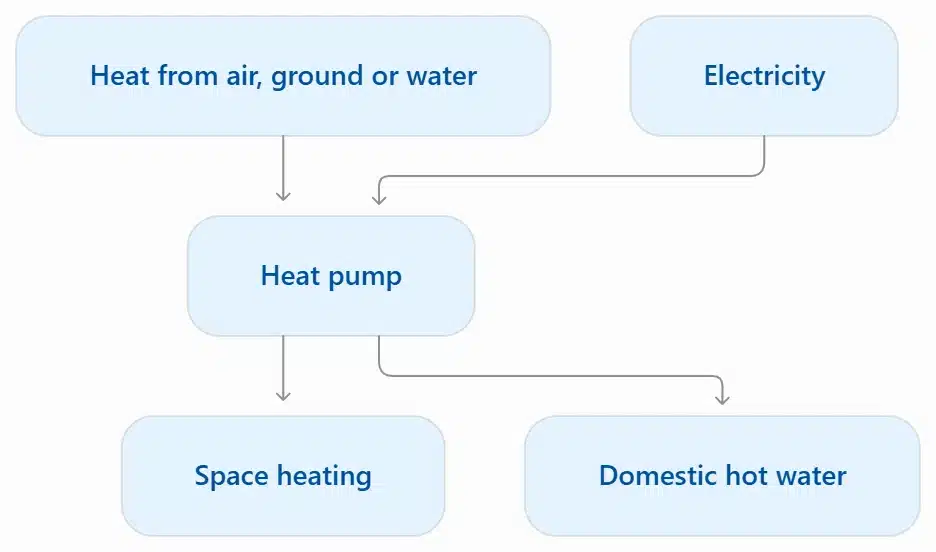
Environmental heat and electricity contribute to the delivered heat. The diagram represents energy flows, rather than pipe connections or simultaneous operating modes.
The critical relationship is the temperature lift: the temperature increase between the heat source and the heat delivered. A smaller lift supports higher efficiency. Low heating demand helps when the home’s heat emitters—the floors, walls or radiators releasing heat into rooms—can maintain comfort with cooler heating water.
Which heat source fits a low energy house?
Air, ground and groundwater can supply a heat pump serving a low energy house. The choice depends on site access, installation constraints and operating conditions. Low demand makes the balance between source installation cost and annual electricity savings particularly important.
The following comparison identifies the site questions that matter before selecting equipment:
| Heat source and system | How heat is collected | Main planning considerations |
|---|---|---|
| Outdoor air: air-to-water heat pump | An outdoor heat exchanger collects heat from air | Winter performance, outdoor-unit position, sound and defrost-water drainage |
| Ground: ground-source heat pump | Buried collectors or boreholes exchange heat with the ground | Available land, ground conditions, drilling access and source design |
| Groundwater: water-to-water heat pump | A groundwater system supplies heat through a suitable heat exchanger | Water availability, water quality, pumping requirements and site permissions |
Energieagentur Tirol, the regional energy agency for Tyrol, identifies outdoor-unit sound, ground suitability and groundwater availability as distinct selection constraints.
For a low energy house, compare the complete installed system. A source arrangement that improves efficiency can still require an investment that takes longer to recover when annual heat consumption is small. Assess that trade-off using the property’s calculated demand and comparable quotations.
How do you size a heat pump for low heating demand?
Size the heat pump from the building’s calculated heat loss at local winter design conditions. Also check its minimum heating output during milder weather. A low energy house needs both adequate winter capacity and controlled operation when demand falls substantially.
The winter design temperature is the outdoor temperature used to calculate the building’s heating requirement. Request a room-by-room heat loss calculation that accounts for the building fabric, ventilation and intended indoor temperatures.
klimaaktiv advises using a calculated heating requirement rather than selecting equipment from estimates alone. Its installation guidance also warns that oversizing increases investment and can reduce efficiency and equipment life.
Why does minimum output matter?
Minimum output determines how far the heat pump can reduce its heating power. A modulating heat pump adjusts compressor operation to vary output, but it still has a lower operating limit.
When the building needs less heat than that minimum, the system must manage the surplus through its controls, available thermal storage or stop-start operation. Repeated short operating periods are called short cycling.
For example, consider a hypothetical house needing 1 kW during mild weather and a heat pump producing at least 2 kW under those same conditions. Continuous operation would produce more heat than the house needs. This example illustrates why maximum capacity alone is an incomplete selection criterion.
Compare minimum and maximum output at the relevant source and heating water temperatures. Compressor speed control can reduce starts, but the complete system design still matters.
What needs checking for cold weather?
The selected model must satisfy the agreed heating strategy at the local design conditions. For an air-source model, request its output and electricity consumption at those conditions, including the planned contribution of any backup heater.
A product’s headline capacity at a milder test temperature does not establish its winter performance.
How do heating, hot water and controls work together?
A heat pump system needs coordinated heating temperatures, hot water preparation and controls. In a low energy house, avoidable storage and distribution losses deserve particular attention because space heating demand is limited. Design each function around its actual operating requirements.
Heating water temperature
Flow temperature is the temperature of the water supplied to the heat emitters. Underfloor and wall heating provide large heat-emitting surfaces, supporting low flow temperatures.
The Upper Austrian energy agency, OÖ Energiesparverband, recommends low-temperature distribution with flow temperatures preferably below 35°C in its residential heat pump guidance. Treat this as a design objective, not a guaranteed setting for every house. Room heat loss and emitter capacity determine the required temperature.
Suitable radiators can also work with a heat pump. Their heat output must be checked at the proposed water temperature rather than assumed from their physical size.
Domestic hot water
Hot water demand remains important even when space heating demand is small. Insulating a house reduces heat escaping through the building fabric; it does not automatically reduce shower or bath consumption.
Consider a hypothetical household using 6,000 kWh for space heating and 2,000 kWh for hot water annually. Hot water represents 25% of that combined useful heat demand. Reducing space heating to 3,000 kWh, with hot water unchanged, raises the hot water share to 40%. These illustrative calculations exclude storage and distribution losses.
Select hot water storage around occupancy, simultaneous use and reheating requirements. Keep pipe routes practical and insulate storage and distribution components. Temperature settings must satisfy the hygiene requirements of the actual installation; lowering them solely to improve efficiency is not an adequate design method.
Heating controls
Weather compensation adjusts heating water temperature as outdoor conditions change. Its heating curve defines that relationship. A suitable curve supplies the temperature needed for comfort without maintaining unnecessarily hot water throughout the heating season.
Hydraulic balancing adjusts water flows through the heating circuits so that rooms receive their required heat. Ask for the balancing settings and commissioning record at handover.
How much electricity does a heat pump use in a low energy house?
Annual heat pump electricity consumption depends on the heat supplied and the system’s annual efficiency. Divide annual heat output by the seasonal performance factor to estimate electricity use. Include hot water and system losses when defining the required heat output.
Three efficiency terms describe different measurements:
| Term | Meaning | Appropriate use |
|---|---|---|
| COP: coefficient of performance | Heat output divided by electricity input at specified operating conditions | Comparing performance at matching test conditions |
| SCOP: seasonal coefficient of performance | Standardised seasonal performance calculated from defined conditions | Comparing product performance under the same climate and temperature assumptions |
| Annual SPF, called JAZ in German | Annual heat delivered divided by annual electricity consumed within a defined system boundary | Estimating or measuring the installed system’s annual performance |
SCOP is a standardised product comparison value. A measured annual SPF reflects the installation and its operation. The Sustainable Energy Authority of Ireland, Ireland’s national energy authority, explains this distinction in its heat pump technology guide.
For context, the International Energy Agency, an intergovernmental energy organisation, describes a typical household heat pump COP as around 4. That operating-performance example is not a guarantee of annual efficiency in a particular home.
An illustrative annual electricity calculation
Assume a heat pump system supplies 8,000 kWh of heat annually, including the heat required for space heating, hot water and associated storage and distribution losses.
Also assume an electricity price of €0.30/kWh. This is a hypothetical calculation input, not a current Austrian tariff.
| Assumed annual SPF | Annual electricity consumption | Electricity cost at €0.30/kWh |
|---|---|---|
| 3.0 | Approximately 2,667 kWh | Approximately €800 |
| 4.0 | 2,000 kWh | €600 |
| 5.0 | 1,600 kWh | €480 |
Calculation: 8,000 kWh ÷ 4.0 = 2,000 kWh of electricity.
The table is a sensitivity calculation, not a predicted performance range. Its SPF must account consistently for the heat supplied and electricity consumed, including relevant auxiliary equipment and backup heating.
The figures exclude cooling, maintenance, fixed electricity charges and financing. Solar electricity also requires a separate calculation because generation and heat pump demand do not always coincide.
How does low demand affect the investment case?
Low annual consumption reduces the absolute value of each efficiency improvement. In this example, increasing SPF from 4.0 to 5.0 saves 400 kWh, worth €120 annually at the assumed tariff.
Compare that saving with any additional installation cost. Request quotations covering equipment, heat-source works, hot water provision, electrical work, controls and commissioning. A payback estimate needs these project-specific costs and a clearly defined comparison system.
Can a heat pump provide cooling and use solar electricity?
A compatible heat pump can cool a low energy house and use electricity from rooftop solar panels. Cooling needs suitable surfaces and condensation protection. Solar electricity reduces grid purchases when generation coincides with demand, but does not guarantee winter independence.
Cooling without condensation
Active cooling uses the compressor to move heat out of the building. Passive cooling transfers heat to a suitable ground or groundwater source without operating the compressor for cooling, although circulation pumps still consume electricity.
Cooling capability depends on the selected model and system configuration. The German Heat Pump Association, Bundesverband Wärmepumpe, distinguishes these arrangements and highlights the need for condensation protection.
The dew point is the temperature at which moisture in the air begins to condense. Cooled floors and other exposed surfaces need controls that prevent condensation. Surface cooling also requires a room-level cooling assessment; a heating-capacity calculation does not establish summer cooling performance.
Photovoltaic electricity
Photovoltaic panels, abbreviated PV, convert sunlight into electricity. Compatible controls can schedule part of the heat pump’s operation, such as hot water reheating, during periods of solar generation.
klimaaktiv identifies daytime hot water preparation as a way to increase direct use of solar electricity. It also notes the lower solar yield during November, December and January. Annual solar production therefore does not demonstrate that the heat pump can operate independently of the grid throughout winter.
Which iDM heat pumps are relevant to low energy houses?
The relevant iDM heat pump family depends on heat source, required output and hot water arrangements. AERO, TERRA and iPUMP provide starting points for evaluation. MAX and NANO address different system requirements and need assessment against the project’s specific needs.
iDM Energiesysteme GmbH is an Austrian heat pump manufacturer. Its product-family names describe different aspects of a system, including the heat source, integrated equipment and intended application.
| iDM family | What the family describes | Relevance to a low energy house |
|---|---|---|
| AERO | Air-source heat pumps | Evaluate when outdoor air is the chosen source. Check minimum output, winter performance and outdoor placement. |
| TERRA | Ground-source and groundwater heat pump solutions | Evaluate when the property supports an appropriately designed ground or groundwater source. |
| iPUMP | Heat pump solutions with integrated hot water storage in the relevant models | Evaluate when an integrated heating and hot water arrangement suits the available space and household demand. |
| MAX | Heat pump solutions for larger heating requirements | Relevant when the calculated total system load justifies larger equipment; low energy classification alone does not establish suitability. |
| NANO | Decentralised heat pumps serving individual dwellings within a wider source arrangement | Relevant to a specific dwelling-level supply concept. iDM positions the iPUMP N5 particularly for apartment refurbishment and neighbourhood solutions. |
Choose the specific model and configuration after checking the calculated load. A family name does not establish minimum output, included cooling equipment, storage suitability or performance at your design temperatures.
What information is needed before choosing a system?
Choose a heat pump using documented building requirements and a complete system proposal. For a low energy house, compare minimum output, design temperature performance, hot water provision and installed cost. Agree how the installer will commission and verify system operation.
Bring the following information to the consultation:
- Building demand: the energy certificate, room-by-room heat loss calculation and intended indoor temperatures.
- Heat distribution: emitter types, calculated flow temperature and heating-circuit arrangement.
- Hot water use: household size, bathing habits, simultaneous demand and available storage space.
- Site conditions: outdoor placement, neighbouring buildings, ground access and electricity supply.
- Comfort functions: cooling requirements, existing PV and preferred operating controls.
At handover, request the commissioned settings, operating instructions and a clear explanation of backup-heater operation.
Arrange a consistent method for recording annual heat output and electricity consumption. Energieagentur Tirol recommends reviewing annual efficiency using heat and electricity meter readings. An unexpected change warrants investigation of settings, consumption patterns and system operation. Wärmepumpe
What else do homeowners ask about low energy heat pumps?
Low energy houses still require decisions about heat distribution, storage and backup operation. These questions concern how the heat pump works within a particular home. Answers depend on the selected equipment and design, so confirm them in the installation proposal.
Does every low energy house need a buffer tank?
A separate buffer tank is not an automatic requirement. A buffer stores heating-system water and can help manage operating cycles or separate water flows. Its necessity depends on the manufacturer’s requirements and the complete hydraulic design. Ask the installer to explain its purpose and sizing. seai.ie
Does a heat pump replace the ventilation system?
The water-based heat pump systems described here do not provide fresh-air ventilation. Ventilation replaces indoor air with outdoor air; the heat pump supplies heating or cooling. A ventilation system with heat recovery transfers some heat from outgoing air to incoming air and must be coordinated with the building’s heating calculation.
Does an electric backup heater mean the system is unsuitable?
Backup-heater operation must be assessed against the intended design. An electric resistance heater converts electricity directly into heat and may serve a defined supplementary function. Ask which conditions activate it and how its electricity consumption is recorded. Include that consumption when assessing annual system efficiency.
Can low annual heating demand guarantee a high annual SPF?
Low heating demand does not guarantee a particular SPF. A home can use little heating energy while its combined efficiency is influenced by higher-temperature hot water production. Compare total electricity consumption alongside SPF, and keep the measurement boundaries consistent.
How do you find the right heat pump for your low energy house?
The right heat pump matches your home’s low heating demand while providing reliable hot water and the comfort functions you need. Start with the energy certificate and a heat loss calculation, then compare suitable iDM models with a qualified installer.
Use your building information to begin an iDM configuration and consultation, with particular attention to minimum output and hot water requirements.