Heat Pumps for Residential Passive Houses
A heat pump uses electricity to transfer heat from a source, such as outdoor air or the ground, to a building. In a residential Passive House, a building designed to meet defined energy-efficiency and comfort criteria, its main applications are space heating, domestic hot water for taps and showers, and cooling where the system supports it.
The central design challenge is matching the heat pump to exceptionally low space-heating demand while maintaining reliable hot-water delivery. A suitable system needs careful capacity selection, coordination with ventilation and a realistic annual energy calculation.




What makes a Passive House different for heat pump design?
A Passive House gives a heat pump a very small space-heating task. Its insulated, airtight building envelope limits heat loss, so equipment selection depends on calculated heating load, minimum output and hot-water demand rather than floor area or building type.
The building envelope comprises the walls, roof, floors, windows and doors separating indoor space from the outside. Passive House design combines insulation and airtightness with efficient windows, reduced thermal bridges—localised paths for heat loss—and controlled ventilation with heat recovery.
The Passive House Institute, the organisation that developed the Passive House standard, publishes the following selected requirements:
| Measure | Passive House criterion | Meaning for heating design |
|---|---|---|
| Annual space-heating demand | No more than 15 kWh/(m²·year) | Limits annual heating energy per square metre |
| Alternative space-heating load criterion | No more than 10 W/m² | Limits required heating power per square metre |
| Airtightness | No more than 0.6 air changes per hour at a test pressure difference of 50 Pa | Limits uncontrolled air leakage |
The heating-demand and heating-load criteria are alternative compliance routes. These values use the standard’s defined reference areas and calculation methods; they are not a complete certification checklist.
A home meeting the annual heating-demand criterion does not automatically have a heating load of exactly 10 W/m². That distinction matters when selecting a heat pump: annual energy demand and peak heating power require separate calculations.
Which heat pump systems suit a residential Passive House?
A residential Passive House can use an air-source, ground-source or groundwater heat pump, provided its output matches the building. Compact ventilation-integrated systems offer another approach. The practical choice depends on heat distribution, source access, hot-water requirements and investment over time.
The principal options differ in how they collect and distribute heat:
| System | Heat source and delivery | Passive House selection priority |
|---|---|---|
| Air-to-water heat pump | Transfers outdoor-air heat into a water-based heating system | Check minimum output, cold-weather performance and outdoor-unit sound |
| Ground-source heat pump | Collects ground heat through buried pipework or boreholes | Assess source installation costs against the building’s small annual heating requirement |
| Groundwater heat pump | Extracts heat from suitable groundwater | Establish water availability, quality and site feasibility |
| Compact ventilation-integrated heat pump | Combines heating, ventilation and hot-water functions; the source arrangement varies | Verify that heating capacity, ventilation airflow and hot-water recovery suit the home |
Energieagentur Tirol, an Austrian regional energy-advice organisation, identifies source availability, ground conditions and sound as relevant selection factors. Groundwater suitability requires a site assessment.
klimaaktiv, Austria’s federal climate-protection initiative, identifies compact heat-pump combination units as an option for small to medium-sized homes with very low energy demand, including Passive Houses.
For a project in Austria, Germany or Switzerland, request a comparison using the actual site’s winter conditions and installation constraints. A system’s technical suitability and its investment case are separate decisions.
How is a heat pump sized for such a small heating load?
Size the heat pump from the Passive House heating-load calculation, then check hot-water recovery and operation during milder weather. Maximum capacity must meet the design requirement, while minimum capacity determines how closely the system can follow the home’s smaller demands.
Heating load is the heating power needed under defined design conditions, expressed in watts or kilowatts. Annual heating demand is energy accumulated over a year, expressed in kilowatt-hours.
The Passive House Planning Package, or PHPP, is a building energy-calculation tool that includes a heating-load method. Use its project results alongside the applicable heating-design requirements; floor area alone does not establish equipment size.
What does a very small heating load look like?
Consider a hypothetical home with 150 m² of treated floor area—the reference area calculated under PHPP rules—and an independently calculated heating load of 10 W/m²:
150 m² × 10 W/m² = 1,500 W = 1.5 kW of space-heating power.
This calculation illustrates scale. It does not select a heat pump, account for hot-water recovery or prove that another 150 m² home has the same load.
Why does minimum output matter?
Modulation means adjusting heat output to demand. A modulating heat pump still has a minimum output below which continuous operation is unavailable.
When that minimum exceeds the heat the building can absorb, the compressor—the component that compresses refrigerant in the heat-pump cycle—must stop and restart. Repeated short operating periods are called short cycling. The design implication is to compare minimum output with mild-weather demand as well as checking maximum capacity.
klimaaktiv warns that oversized heating systems increase investment costs and can reduce heat-pump efficiency and service life.
Ask the designer to document:
- Maximum heating capacity at the project’s winter design conditions.
- Minimum output at relevant source and heating-water temperatures.
- Hot-water storage capacity and reheating time.
- The operating strategy when room-heating demand falls below minimum output.
How do heating and heat-recovery ventilation work together?
A heat pump supplies useful heat, while heat-recovery ventilation reduces heat lost during air exchange. These functions work together in a Passive House. Separate equipment or an integrated system can provide them, depending on the verified heating and ventilation design.
Mechanical ventilation with heat recovery exchanges indoor and outdoor air while transferring heat from the outgoing air to the incoming air through a heat exchanger. Heat recovery reduces ventilation heat losses; the building can still require additional heating.
The following diagram shows a water-based heat pump alongside a separate ventilation system:
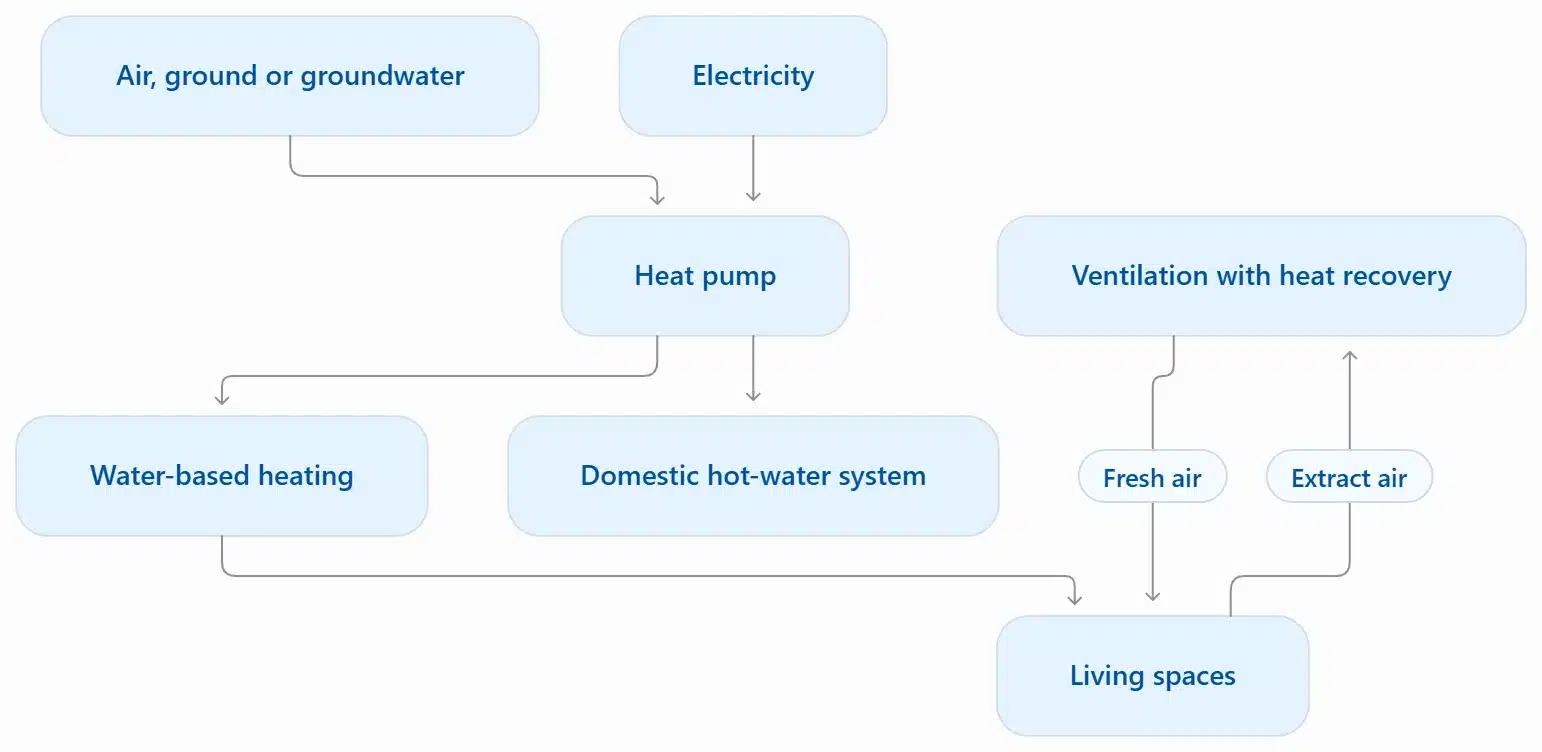
The heat pump supplies heating and hot water. The ventilation system exchanges air and recovers heat. This is a functional schematic, not an installation drawing.
Water-based, or hydronic, heating circulates heated water through surfaces such as underfloor or wall heating. The flow temperature is the temperature of water supplied to those surfaces. Design for the lowest flow temperature that maintains comfort throughout the home; lower temperatures support heat-pump efficiency.
Heating through the ventilation supply air is another option, but the available airflow limits the heat it can transport. The designer must verify that capacity for the actual rooms. Increasing ventilation solely to compensate for inadequate heating requires reassessment of the ventilation design.
Why does hot water need separate attention?
Domestic hot water needs its own heat pump calculation because insulation reduces space-heating demand without reducing the water used for showers and washing. Storage volume, reheating time and distribution losses therefore become central to designing an efficient residential Passive House.
Hot-water demand follows occupancy and use. A small space-heating load does not establish how much stored hot water a household needs or how soon the storage must recover after consecutive showers.
A hot-water cylinder stores heated drinking water. Its useful capacity depends on storage temperature, incoming cold-water temperature and the required delivery temperature. Select storage and reheating capacity together rather than enlarging the heat pump automatically.
Hot-water distribution also consumes energy. Heat escapes from storage and pipework between uses. A circulation loop, which moves hot water around the distribution system to shorten waiting times, creates an additional heat-loss path. Short, insulated pipe routes help limit these losses.
The hot-water temperature strategy must satisfy the installation’s hygiene requirements. Space-heating flow temperatures and drinking-water storage temperatures serve different purposes; reducing one does not justify reducing the other. Have the designer document the applicable requirements and controls.
What efficiency and running costs can you expect?
Heat pump running costs depend on annual heat demand, seasonal efficiency and the electricity tariff. A Passive House limits space-heating demand, but hot water and system losses remain. Calculate these separately before comparing equipment, energy bills or potential investment savings.
Three efficiency measures answer different questions:
| Measure | Definition | Appropriate use |
|---|---|---|
| COP: coefficient of performance | Heat output divided by electrical input at a specified operating point | Comparing performance under matching test conditions |
| SCOP: seasonal coefficient of performance | Seasonal performance calculated under standardised conditions | Comparing products for the same climate and temperature application |
| SPF: seasonal performance factor; commonly expressed as JAZ in German | Heat delivered divided by electricity consumed over the measured period and stated system boundary | Assessing the installed system’s annual performance |
A system boundary specifies which equipment and energy flows the calculation includes. Check whether pumps, controls and supplementary electric heating are included. A published COP or SCOP is not a prediction of the home’s annual electricity bill.
What does an illustrative annual calculation show?
The following example uses assumptions, not measured results or a current electricity-price quotation.
| Input or result | Hypothetical value |
|---|---|
| Treated floor area | 150 m² |
| Annual space-heating demand | 15 kWh/(m²·year) |
| Annual useful space heat | 2,250 kWh |
| Hot-water energy plus relevant net storage and distribution losses | 2,500 kWh/year |
| Total annual heat supplied by the heat-pump system | 4,750 kWh |
| Assumed combined SPF | 4.0 |
| Calculated heating-system electricity | 1,187.5 kWh/year |
| Assumed electricity unit price | €0.30/kWh |
| Calculated variable electricity cost | €356.25/year |
The calculation is:
4,750 kWh of heat ÷ 4.0 SPF × €0.30/kWh = €356.25 per year.
The assumed SPF covers the heating-system electricity within the example’s boundary. Ventilation electricity, household appliances, cooling, fixed electricity charges and maintenance are excluded.
How does low demand affect the investment decision?
In the same example, improving SPF from 3.0 to 4.0 saves approximately 396 kWh of electricity, or €119 per year at the assumed tariff.
This illustrates why percentage efficiency improvements need an annual euro calculation. A higher-efficiency system can save electricity while offering limited financial savings when the total heat requirement is small.
Request quotations covering equipment, heat-source installation, hot-water provision, distribution, electrical work and commissioning. Compare the complete installed scope, maintenance and expected energy use; a universal Passive House installation price would conceal these differences.
Can a heat pump cool a Passive House?
A compatible heat pump can cool a Passive House, but cooling starts with controlling unwanted heat gains. External shading and suitable ventilation reduce the load. Active or ground-assisted cooling then requires a separate assessment of capacity, humidity and condensation protection.
A low winter heating requirement does not establish summer comfort. The Passive House Institute identifies solar gains, internal heat sources and ventilation strategy as major influences on summer temperatures. Assess shading and summer operation before selecting cooling capacity.
Active cooling uses the heat pump’s compressor to remove heat from the building. Passive cooling, also called free cooling in this context, transfers building heat to a sufficiently cool ground or groundwater source without running the compressor for that cooling function. Circulation pumps and controls still consume electricity. Availability depends on the equipment and source design.
Cooling floors or ceilings requires protection against condensation. The dew point is the temperature at which moisture in the air begins to condense. Controls must prevent cooled surfaces from reaching conditions that cause unwanted condensation. Surface cooling also needs a separate humidity assessment; it does not provide the moisture removal of a dedicated dehumidifying system.
Which iDM heat pump families are relevant to Passive Houses?
iDM heat pump families describe different heat sources, equipment arrangements and capacity needs. For a residential Passive House, compare suitable AERO, TERRA and iPUMP models against the calculated load. MAX and NANO become relevant only where the project warrants them.
iDM Energiesysteme GmbH is an Austrian heat-pump manufacturer. Its product-family names describe different selection dimensions; they are not five interchangeable Passive House systems.
| iDM family | What the name describes | Relevance to a Passive House |
|---|---|---|
| AERO | Air-source heat pumps | Assess an air-to-water model where outdoor-unit installation is suitable; verify capacity at both low demand and winter design conditions |
| TERRA | Ground-source and groundwater heat pumps | Assess where a suitable source is available and its installation is justified by the project |
| iPUMP | Integrated heat-pump solutions with hot-water storage in the relevant models | Assess where equipment space and coordinated hot-water provision matter |
| MAX | Larger-capacity heat-pump systems | Consider only when a shared project’s combined load justifies the capacity |
| NANO | Decentralised heat-pump solutions serving individual apartments | Consider only within a specifically designed dwelling-level system with an appropriate heat source |
For a concrete example, iDM describes the iPUMP T7 ONE, a ground-source or groundwater model with integrated hot-water storage, as having a 2–7 kW heating-capacity range. That published range alone does not establish suitability for the hypothetical 1.5 kW space-heating load above. Compare the detailed operating data and hot-water requirement before selection.
Integrated hot-water storage does not establish that a product also contains a ventilation system. Confirm each model’s functions, minimum output, cooling equipment and local availability.
What else do homeowners ask about Passive House heat pumps?
A Passive House heat pump still needs electricity, maintenance and coordinated controls. Solar generation can support operation, while storage and backup heating depend on the system design. These details influence comfort and annual consumption even when space-heating demand is low.
Can photovoltaic panels supply the heat pump?
Photovoltaic panels, which convert sunlight into electricity, can supply part of the heat pump’s electricity demand. The contribution depends on when generation and consumption occur. Annual solar production does not establish winter self-sufficiency. Calculate seasonal overlap and any planned hot-water scheduling.
Is an air-to-air heat pump an alternative?
An air-to-air heat pump can provide space heating where its room coverage and capacity suit the building. It delivers heat directly to indoor air, so hot-water production needs a separate solution. Passive House Institute research identifies this arrangement as an alternative in a specific compact-system replacement study; that finding does not establish the best option for every home.
Is electric backup heating always necessary?
Backup provision depends on the selected heat pump and the design conditions. Ask the installer to identify when supplementary heating operates and include its expected electricity consumption in the annual estimate. A built-in electric heating element establishes that backup is available, not how frequently it will run.
How can actual performance be checked?
Compare measured heat delivery and electricity use over the same period and system boundary. Record hot-water settings and supplementary-heater operation so changes in consumption can be investigated. Request operating instructions and a maintenance schedule at handover.
How do you choose a heat pump for your Passive House?
Choose a heat pump for your Passive House by bringing the building calculation, hot-water requirements and ventilation concept together. Ask the installer to demonstrate capacity matching and expected annual consumption, then compare suitable equipment using the same assumptions and scope.
Prepare four inputs for an iDM consultation:
- Building calculation: PHPP results, treated floor area and room heating requirements.
- Hot-water profile: occupancy, expected simultaneous use and storage-space constraints.
- System concept: heat distribution, ventilation arrangement and any cooling requirement.
- Site information: location, available heat sources and equipment-placement constraints.
The decisive specification is a system that serves the home’s small heating load and its separate hot-water needs. Use the iDM configuration process to begin the product discussion, followed by a project-specific design check.