Heat Pumps for Single-Family Homes: Heating, Hot Water and Cooling
Heat pump applications in single-family homes include space heating, domestic hot water and, with compatible equipment, summer cooling. A heat pump is an electrically powered system that transfers heat from the environment into the home. Domestic hot water means the heated drinking-quality water used at taps, showers and baths.
Here, a single-family application means a system serving one self-contained home. The main decisions concern that household’s heating demand, hot water use, available heat source and installation space.




How does a heat pump serve a single-family home?
A heat pump supplies room heating and domestic hot water by transferring environmental heat into the home’s water circuits. Compatible systems also provide cooling. Each service needs suitable equipment and controls, with hot water demand planned separately from room heating.
Inside the heat pump, a refrigerant—a fluid that carries heat—circulates through a closed circuit. An electrically driven compressor raises its pressure and temperature. Heat exchangers transfer this energy between circuits without mixing their fluids.
The following diagram shows a simplified household arrangement in heating mode.
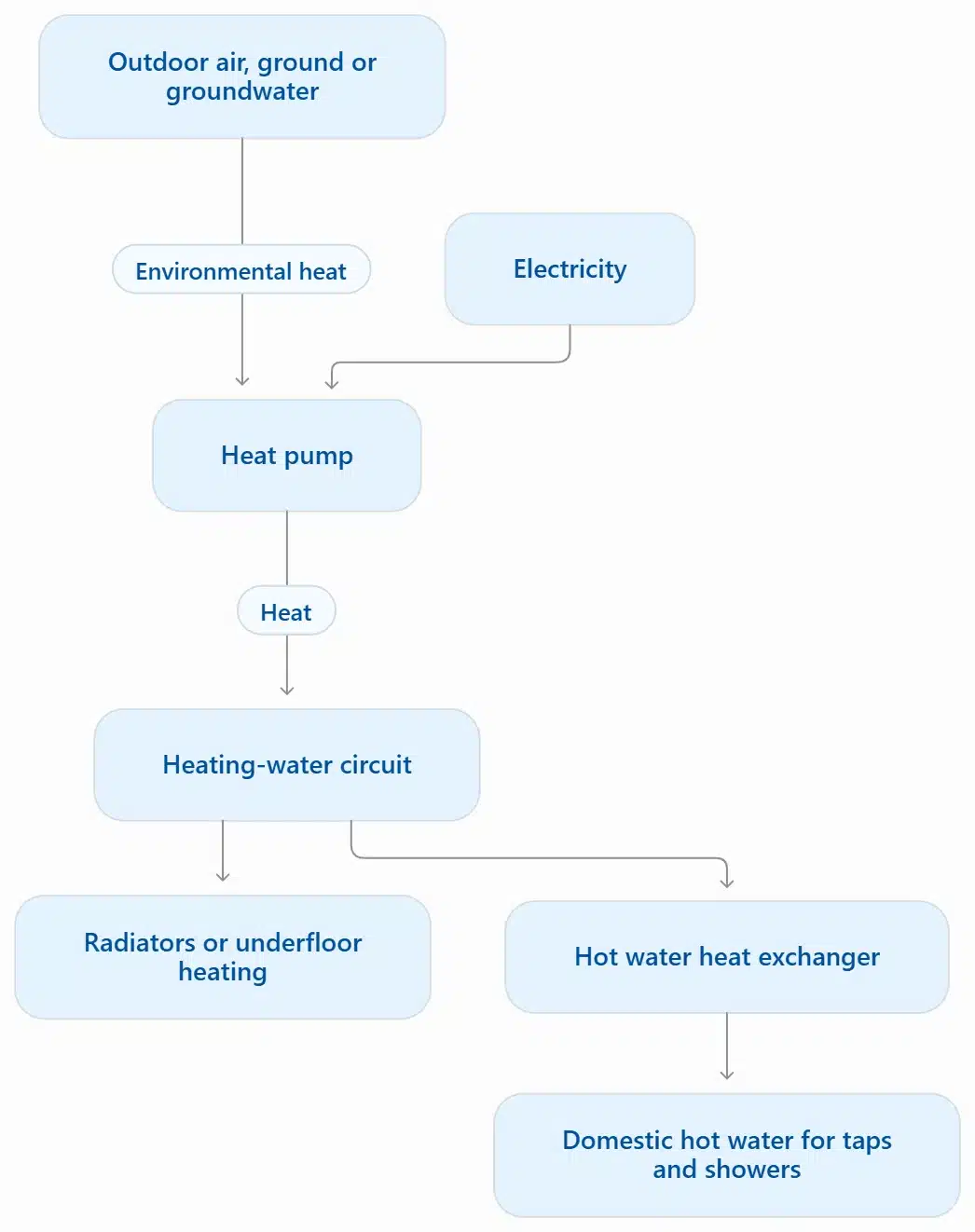
The heating-water circuit distributes heat around the home. The hot water heat exchanger keeps drinking water separate from heating water. Return pipes, storage arrangements and control valves are omitted for clarity.
Room heating
The heat pump supplies warm water to heat emitters, the components that release heat into rooms. These include radiators and underfloor heating pipes. Their required water temperature influences heat pump efficiency, so emitter selection and heat pump selection belong in the same design process.
Domestic hot water
Hot water provision must match the household’s usage pattern. Two showers running together create a different requirement from showers used consecutively. The installer therefore considers water storage, peak draw-off demand and recovery time—the time needed to replenish available hot water.
Hot water temperature and hygiene settings require a coordinated design. Raising water temperature increases the heat pump’s electricity requirement, while hygiene requirements must remain satisfied.
Optional summer cooling
Cooling requires a compatible heat pump and a suitable room-side distribution system. Active cooling uses the compressor. Passive cooling transfers heat to a cooler ground or groundwater source without running the compressor for that cooling function; circulation pumps still consume electricity.
Floor or wall cooling needs condensation control. Surfaces must remain above the dew point, the temperature at which moisture in the surrounding air condenses. Standard radiators must not simply be supplied with chilled water.
Which heat source suits a single-family home?
A heat pump can collect heat from outdoor air, the ground or groundwater. The suitable source depends on the property’s available space, ground conditions, permissions and budget. Compare each option against the same household heating requirements and expected operating conditions.
The three source options involve different property requirements.
| Heat pump type | How it obtains environmental heat | Main property requirement |
|---|---|---|
| Air-to-water | Extracts heat from outdoor air and transfers it to heating water | Suitable outdoor positioning, airflow and acoustic planning |
| Ground-source, commonly brine-to-water | Circulates brine—a water and antifreeze mixture—through buried collectors or borehole loops | Suitable land or drilling access, with a correctly designed ground circuit |
| Groundwater-source, commonly water-to-water | Extracts heat from groundwater through a designed water circuit | Suitable groundwater availability, wells and permission to use the source |
Ground and groundwater sources offer more stable winter source temperatures. Air-source systems avoid the groundworks associated with collectors or boreholes. The appropriate choice depends on site feasibility and the complete installation cost.
For an air-source proposal, request heating output and electricity consumption at the temperatures relevant to your location. A catalogue rating at mild outdoor conditions does not establish performance on a cold winter day. Also ask how any auxiliary heater—an additional heat source, such as an electric heating element—contributes during peak demand.
What size heat pump does your home need?
Heat pump sizing starts with the home’s calculated heating load at local winter design conditions. Floor area alone cannot determine the correct size. The installer also checks room heating temperatures, hot water recovery requirements and operation during milder outdoor conditions.
Heating load, measured in kilowatts (kW), describes the heat output needed to maintain the specified indoor temperature under defined cold-weather conditions. Annual heat demand, measured in kilowatt-hours (kWh), describes energy used over a year. These measurements answer different questions: equipment capacity and annual consumption.
Request a calculation for the building and its rooms. The installation design also needs to account for hot water demand and any planned supplementary heating.
Can the heat pump work with radiators?
Radiators can work with a heat pump when they deliver enough heat at the selected water temperature. Underfloor heating is one option, rather than a universal requirement. Room-by-room checks identify whether an existing radiator is adequate or needs changing.
The flow temperature is the temperature of water leaving the heating system for the emitters. Austria’s climate initiative, klimaaktiv, identifies adequate room heating at a maximum flow temperature of 55°C on a cold winter day as a useful suitability indicator. Treat this as an initial screening check, followed by a professional design calculation.
Why does minimum output matter?
Maximum output establishes cold-weather capability. Minimum output determines how far a modulating heat pump can reduce its heating power as demand falls.
An oversized unit with excessive minimum output can repeatedly start and stop during mild weather. Ask the installer to explain both ends of the operating range and how the proposed system handles them.
How efficient is a heat pump in everyday use?
Heat pump efficiency describes how much heat the system delivers for each unit of electricity consumed. Annual performance depends on source temperatures, heating water temperatures and system operation. Compare seasonal estimates for your home rather than relying on laboratory figures.
Three efficiency terms appear in product literature and installation proposals.
| Measure | Meaning | Appropriate use |
|---|---|---|
| COP: coefficient of performance | Heat output divided by electrical input at a specified operating condition | Comparing equipment at matching test conditions |
| SCOP: seasonal coefficient of performance | Seasonal performance calculated using standardised operating and climate conditions | Comparing product ratings on a consistent basis |
| SPF: seasonal performance factor; annual JAZ in German-language guidance | Heat delivered divided by electricity consumed over the stated period and measurement boundary | Estimating or assessing the installed system |
SCOP is not a prediction of your electricity bill. An installation-specific annual estimate accounts for the household’s operating conditions.
The measurement boundary specifies which energy flows are included. Ask whether an efficiency estimate covers space heating, hot water, source pumps, controls and auxiliary heating. Comparisons are meaningful only when their boundaries match.
What does measured performance show?
The Fraunhofer Institute for Solar Energy Systems ISE, a German applied research institute, evaluated 49 air-source heat pumps during 2024 within its existing-home research project. Their measured seasonal performance factors ranged from 2.6 to 4.9, averaging 3.4.
These results demonstrate variation between installations. They are evidence from the monitored sample, not a guaranteed result for an Austrian home or a particular iDM model.
A heat pump combines environmental heat with electricity. Its operating climate impact therefore depends on both the electricity supply and achieved efficiency. Low-emissions electricity strengthens the environmental benefit.
What does a heat pump cost to install and run?
A heat pump’s electricity cost depends on annual heat demand, seasonal efficiency and the electricity tariff. Installation costs depend on equipment and site work. Evaluate both using an itemised quotation and a calculation that includes heating, hot water and auxiliaries.
How can you estimate annual electricity costs?
For an initial estimate using consistent energy boundaries:
Annual electricity consumption = annual heat supplied ÷ annual performance factor
Annual electricity cost = annual electricity consumption × electricity price
The following hypothetical example uses 12,000 kWh of annual heat supplied and an assumed electricity price of €0.30/kWh. These are illustrative inputs, not an Austrian tariff quotation or a forecast for your property.
| Illustrative annual performance factor | Annual heat supplied | Calculated electricity consumption | Calculated electricity cost |
|---|---|---|---|
| 3.0 | 12,000 kWh | 4,000 kWh | €1,200 |
| 4.0 | 12,000 kWh | 3,000 kWh | €900 |
With these assumptions, increasing the performance factor from 3.0 to 4.0 reduces electricity consumption and its associated cost by 25%. The calculation excludes maintenance and fixed charges. Cooling electricity also needs separate treatment when cooling is outside the stated performance boundary.
What belongs in the installation quotation?
Request an itemised offer covering:
- Equipment: heat pump, controls and the specified hot water arrangement.
- Source and site work: outdoor foundations, excavation, drilling or wells where relevant.
- Building connections: pipework, electrical work and agreed emitter changes.
- Completion: commissioning, operating instructions and documented handover.
Where can heat pump equipment be installed?
Heat pump installation needs space for the selected equipment, access for maintenance and a suitable connection to the heating system. Outdoor placement also requires acoustic planning and drainage. Confirm indoor storage dimensions, electrical requirements and source access before choosing equipment.
Outdoor location affects both comfort and installation feasibility. Ask for an assessment that considers nearby bedroom windows, neighbouring homes and the proposed operating conditions. The manufacturer’s installation instructions determine the clearances and airflow requirements for the selected unit.
Indoor planning includes equipment dimensions, delivery access and space to service components. An integrated hot water unit can simplify the arrangement, but the complete installed space requirement includes connections and maintenance access.
Have the installer confirm the electrical connection and any permissions before ordering. The applicable requirements depend on the location and heat source; Austrian guidance cannot automatically be transferred to Germany or Switzerland.
Can a heat pump use electricity from solar panels?
A heat pump can use electricity generated by photovoltaic panels, which convert sunlight into electrical energy. Coordinating operation with solar production can reduce grid purchases. Winter heating still needs a reliable electricity supply when solar generation cannot cover household demand.
Photovoltaics, abbreviated PV, supplies electricity rather than heat. The heat pump can consume that electricity while collecting additional thermal energy from its environmental source.
Controls can schedule suitable activities, such as hot water heating, during periods of solar production. The useful result depends on generation, household consumption and available heat storage. Annual solar production alone does not establish how much solar electricity the heat pump uses directly.
Request an estimate of self-consumption, the share of generated solar electricity used on the property. Increasing stored-water temperatures solely to absorb surplus electricity also needs an efficiency assessment, because higher operating temperatures can increase electricity demand.
Which iDM heat pump families are relevant to single-family homes?
iDM Energiesysteme GmbH, an Austrian heat pump manufacturer, offers AERO air-source systems, TERRA ground-source systems and iPUMP systems with integrated hot water storage. For single-family homes, select suitable equipment around household demand, available space, heat source and required operating temperatures.
The product families describe different aspects of system selection.
| iDM family | Defining characteristic | Relevant household decision |
|---|---|---|
| AERO | Air-source heat pumps using outdoor air | Whether the property offers a suitable outdoor location and the selected model meets heating requirements |
| TERRA | Heat pumps using ground or groundwater energy | Whether the source can be developed appropriately for the property |
| iPUMP | Heat pumps with integrated hot water storage, including air-source and ground-source options | Whether an integrated arrangement meets the household’s hot water and space requirements |
AERO and TERRA primarily distinguish heat-source approaches. iPUMP identifies an integrated storage arrangement, so source selection and equipment packaging are separate decisions. Confirm heating output, cooling provision and storage characteristics for the individual model.
MAX is iDM’s family for larger heat pump applications. It requires selection against a project’s calculated demand rather than an assumption that greater capacity benefits an individual house.
NANO addresses decentralised apartment-level heat pump applications. Its building-system context differs from selecting a standalone system for one single-family home.
What else do homeowners ask about heat pumps?
A heat pump needs electricity, a defined maintenance plan and compatible connected equipment. A buffer tank is necessary only when the system design requires one. Ask your installer to document these requirements, including any backup supply and routine service tasks.
Does every heat pump need a buffer tank?
No. A buffer tank is selected for a defined system function. It stores heating water and can help meet requirements for water volume, flow management or temporary heat storage. Its necessity depends on the manufacturer’s system arrangement and the building’s heating circuits.
Is a buffer tank the same as a hot water cylinder?
No. The two stores serve different purposes. A heating buffer contains water used within the heating system. A domestic hot water cylinder stores water intended for household use. Their hydraulic and hygiene requirements differ.
What happens during a power cut?
The heat pump stops operating without an electricity supply. Its compressor, pumps and controls require electrical power. Continued operation requires a separately designed backup supply capable of supporting the equipment.
What maintenance does a household heat pump require?
Follow the selected manufacturer’s maintenance instructions. Ask the installer to document service tasks, fault reporting and homeowner checks at handover. A single maintenance interval cannot be assigned to every heat pump type and installation.
How do you choose the next step for your home?
Choose a heat pump around your household’s heating and hot water needs, then confirm the available heat source and installation conditions. Start with a configuration, and have an installer verify the heating load, required temperatures and complete system before purchase.
Prepare your floor plans, available energy-use records, household hot water requirements and preferred equipment locations. Include any requirement for cooling or PV integration so the consultation covers the complete system.
The iDM configurator provides an initial route for single-family homes. Use the resulting configuration as the starting point for a consultation and a property-specific installation proposal.