Heat Pump Defrost Cycle: How It Works and What Is Normal
A heat pump defrost cycle is an automatic process that removes frost from an air-source heat pump’s outdoor heat exchanger. The system temporarily warms this heat-transfer surface, melting the frost so normal heat collection can resume.
A heat pump uses electricity to transfer heat from a source into a building. An air-source heat pump collects that heat from outdoor air. Its outdoor heat exchanger, also called a coil, can develop frost during heating.
Defrosting is part of normal winter operation. The important distinction is whether the frost clears and heating resumes, or whether ice persists and restricts operation.




Why does frost form on an air-source heat pump?
Frost forms when moisture in outdoor air freezes on the heat pump’s cold outdoor coil. The coil can be below 0°C even when the air is warmer. Accumulating frost restricts airflow and heat transfer, making periodic defrosting necessary during heating.
The outdoor coil must be colder than the surrounding air to absorb heat. Its surface temperature therefore matters more for frost formation than the temperature shown on an outdoor thermometer.
For example, in a hypothetical situation with outdoor air at +3°C, the coil surface can still be below freezing. Moisture reaching that surface can freeze even though there is no snow on the ground.
Frost accumulation depends on both temperature and available moisture. Damp weather near freezing can create defrost demand; outdoor temperature alone does not determine the number of cycles.
How does a heat pump defrost cycle work?
A heat pump defrost cycle temporarily redirects heat to the outdoor coil to melt accumulated frost. In reverse-cycle defrosting, normal heat delivery pauses while the coil warms. Meltwater drains away, and the controller then returns the unit to heating mode.
Reverse-cycle defrosting changes the direction of heat transfer. A reversing valve redirects the refrigerant—the fluid that carries heat inside the sealed circuit—so the outdoor coil releases heat.
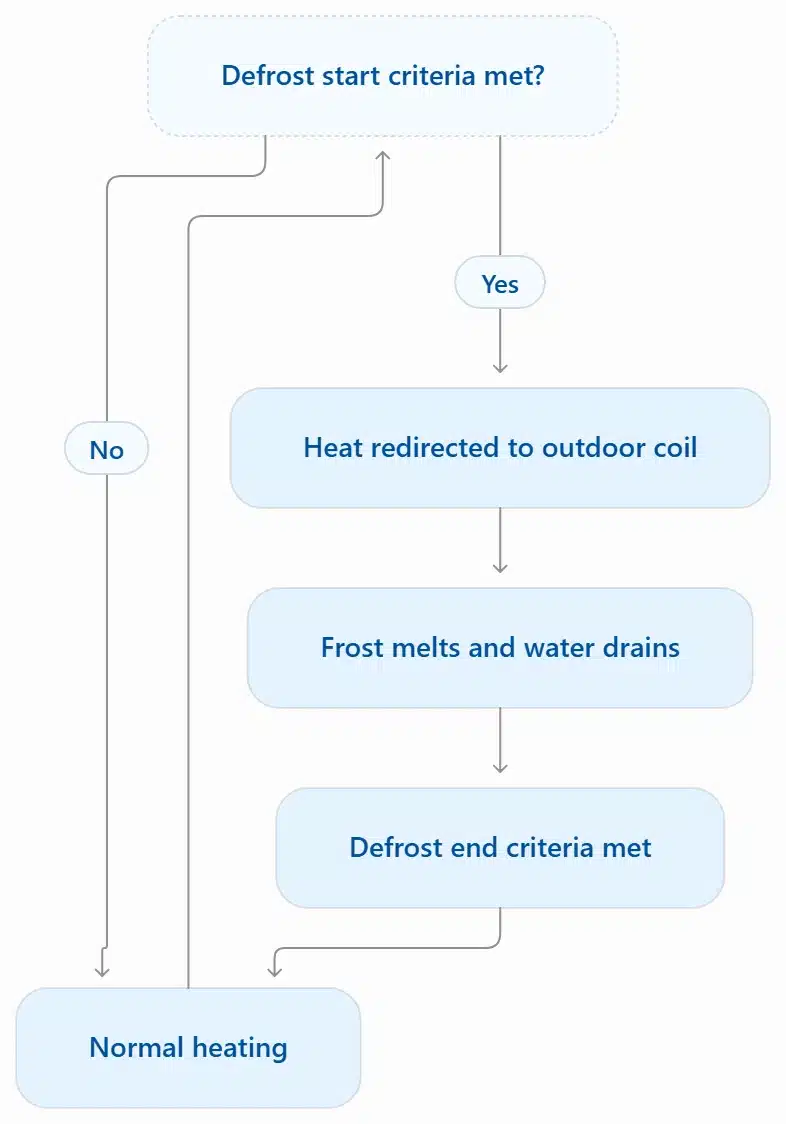
The diagram shows the operating sequence, rather than the complete refrigerant circuit.
During reverse-cycle defrosting, the outdoor fan can stop to limit heat loss from the warming coil. A stopped fan during a recognised defrost cycle does not by itself indicate a fault.
The controller, the unit that manages operation, determines when defrost starts and ends. Demand-based control uses measurements associated with frost accumulation. Time-and-temperature control combines timing with temperature conditions. The exact logic depends on the equipment.
How long does defrosting take, and how often does it happen?
A defrost cycle can last around 5–15 minutes, but this is an indicative manufacturer range, not a specification. Frequency depends on weather, frost accumulation and control logic. The correct benchmark is the operating guidance for your particular heat pump.
The 5–15-minute range comes from iDM general guidance. It is not a universal pass-or-fail limit.
There is also no universal requirement to defrost once per hour. Demand-based systems respond to operating conditions, while other controls incorporate preset intervals. Unnecessary defrost cycles consume energy without providing a useful frost-removal benefit.
For an existing installation, assess three observations together:
- Does frost clear during the cycle?
- Does normal heating resume?
- Does the building maintain its intended temperature?
A changing cycle count during changing weather does not establish a fault. Repeated unsuccessful cycles need investigation.
What happens to heating and efficiency during defrost?
Defrosting temporarily reduces useful heat delivery and consumes electricity, but removing frost restores the heat pump’s ability to collect outdoor heat. Its effect on annual efficiency depends on weather, equipment and installation; no single loss percentage applies to every system.
In an air-to-water heat pump, which transfers outdoor heat into a water-based heating system, reverse-cycle defrosting can draw thermal energy from the heating water. The installation therefore needs enough accessible water volume and thermal energy to complete the process. Energy Saving Trust, an independent energy organisation, identifies this as a system-design requirement.
A pause in heat production does not mean room temperature immediately falls by the same amount. Water, floors and the building retain heat. The effect on comfort depends on that stored heat, the building’s heat loss and the duration of the interruption.
Does defrosting make a heat pump inefficient over winter?
Defrosting creates an energy penalty, but it does not by itself determine annual efficiency. Assess heat delivered and electricity consumed over a representative period, including defrost operation.
The annual performance factor, called Jahresarbeitszahl or JAZ in German, expresses annual heat output divided by electricity input within a defined measurement boundary. Energieagentur Tirol, an Austrian energy advisory organisation, recommends checking this figure using heat and electricity meters.
Real-world results provide useful context. The Fraunhofer Institute for Solar Energy Systems ISE, a German research institute, evaluated 49 air-source heat pumps in existing homes during 2024. Their annual performance factors ranged from 2.6 to 4.9, averaging 3.4. These are installation-level results, not measurements of defrost losses or guarantees for an iDM system.
How much electricity does one defrost cycle use?
Electricity use depends on the measured electrical input and cycle duration; duration alone is insufficient.
Consider a hypothetical example with an average electrical input of 1.5 kilowatts (kW) over six minutes:
1.5 kW × 6/60 hours = 0.15 kilowatt-hours (kWh)
At an assumed electricity price of €0.30/kWh, that interval costs €0.045, or 4.5 cents.
This calculation covers electricity during the interval only. It does not quantify the full additional cost of defrosting, including subsequent replacement of heat drawn from the heating circuit. None of these assumed values describes a particular iDM model.
Where does the water from defrosting go?
Defrost water drains from the outdoor coil into the unit’s collection and drainage system. The drainage route must remain functional in freezing conditions. Water that cannot escape can refreeze, creating ice beneath the heat pump or around its lower components.
Drainage is part of winter performance, not simply a matter of appearance. iDM’s installation guidance for the AERO ALM and iPUMP ALM equipment covered by that document states that up to 15 litres of water can occur during one defrost cycle in extreme cases. This is a documented extreme, not a typical quantity for every cycle or model.
For an Austrian or other Alpine installation, ask the installer how the drain will remain functional during frost and how the outdoor unit’s position accommodates expected snow accumulation.
When does heat pump icing need professional attention?
Heat pump icing needs professional attention when ice remains after defrosting, repeatedly obstructs airflow or accompanies fault messages and inadequate heating. A temporary frost layer that clears during a completed cycle is different from ice that persists or keeps accumulating.
Use the following observations to distinguish an operating event from a reason to request service.
| Observation | Interpretation | Appropriate action |
|---|---|---|
| A frost layer forms, clears during defrost and heating resumes | Consistent with normal defrost operation | Allow automatic operation to continue |
| A brief white mist appears and water drains during defrost | Consistent with moisture released during defrost | Observe whether the cycle completes |
| Thick ice remains across the coil after completed cycles | Frost removal is incomplete | Contact the installer or service partner |
| Repeated defrost attempts accompany falling room temperature or fault messages | The system needs assessment | Record the symptoms and request service |
| Drainage water repeatedly refreezes around the unit or on a walkway | Drainage or siting needs attention | Keep the affected walkway clear of use and arrange inspection |
Water and a visible white plume during defrost are recognised operating effects. Defrosting can discharge water or steam from the outdoor unit.
A photograph alone cannot identify the cause of persistent icing. Ask the technician to assess airflow, drainage, sensor readings and the heating circuit’s available flow and thermal energy.
For a useful service record, capture the model name, displayed fault code, outdoor conditions and cycle start and finish times. Photograph the coil before and after a completed cycle without opening the casing.
How can you support reliable defrosting?
Reliable heat pump defrosting depends on unobstructed airflow, effective drainage and enough available heat in the heating circuit. Owners can keep surrounding areas clear and observe operation. Installers must establish the required water flow, system volume and equipment settings correctly.
For homeowners and facility managers, the practical tasks are:
- Keep snow, leaves and stored objects away from the air inlet and outlet.
- Observe whether defrost water drains away.
- Leave automatic defrost settings at their commissioned values.
- Follow the model’s maintenance and fault instructions.
Do not chip ice off the coil with tools or apply a flame or heat gun. Follow the exact model instructions for any permitted de-icing assistance; request service when automatic defrosting does not restore operation.
For contractors, check the water volume that remains available when heating zones close. Total installed water volume is not necessarily the volume accessible during defrost. The manufacturer’s minimum requirements must remain satisfied in the relevant operating states.
For systems serving larger buildings, include defrost interruptions when assessing available winter heating capacity. Record how the proposed system maintains heat delivery during those interruptions.
What other questions arise about heat pump defrosting?
Heat pump defrosting is automatic during normal operation. Manual intervention, backup heating and buffer tanks depend on the installed system. Defrost also differs from frost protection, which prevents water inside equipment and pipes from freezing rather than clearing outdoor coils.
Can I start a defrost cycle manually?
Normal defrost cycles do not require manual activation. Use a manual function only when the operating instructions explicitly provide it for users. Repeatedly forcing cycles is not a substitute for diagnosing persistent ice.
Does every defrost cycle use an electric backup heater?
No. Electric backup heating is not an inherent requirement of every defrost cycle. A backup heater is an additional heat source; whether it operates during defrost depends on the system design, available stored heat and controls.
Does a buffer tank prevent defrosting?
No. A buffer tank stores heating water and can make thermal energy available during defrost; it does not prevent frost forming on the outdoor coil. The need for a tank and its size depend on the manufacturer’s approved system design.
Does defrost protect outdoor water pipes from freezing?
No. Outdoor-coil defrosting and water-circuit frost protection perform different tasks. A functioning defrost cycle does not establish that exposed water pipes are protected. Follow the installation’s separate frost-protection instructions, including its provisions for power interruptions.
Which iDM heat pumps need outdoor-coil defrosting?
For iDM heat pumps, outdoor-coil defrosting depends on the heat source and system arrangement. Air-source models need frost management at their outdoor coils. Ground-source and groundwater models do not need this air-coil process. Product family names cannot establish every requirement.
iDM Energiesysteme GmbH, an Austrian heat-pump manufacturer, offers product families with different heat sources and applications. Their relevance to defrosting is outlined below.
| iDM product family | Product context | Relevance to defrosting |
|---|---|---|
| AERO | Heat pumps using outdoor air | Outdoor-coil defrosting is relevant during frost-forming conditions. |
| TERRA | Heat pumps using the ground or groundwater | These source arrangements have no outdoor air coil requiring this defrost process. |
| iPUMP | Heat pumps with integrated hot-water storage, including air-source and ground-source configurations | Check the specific model’s heat source; integrated storage alone does not determine defrost requirements. |
| MAX | Heat pumps for larger buildings, with air-source and ground-source options | Defrost requirements depend on the selected source and equipment. |
| NANO | Decentralised apartment heat pumps supplied through a shared source system | Assess the shared source equipment. An upstream air-source heat pump can require defrosting even when the apartment unit has no outdoor air coil. |
The NANO distinction follows from the system arrangement: iDM documents an installation where an AERO air-source heat pump contributes heat to the shared supply. Defrost therefore needs consideration at the appropriate equipment level.
For a purchasing decision, ask how the proposed system handles defrost, maintains heating-water availability and drains meltwater at your site. Request a winter-performance assessment for the actual building and local conditions.
Explore the relevant iDM product family and discuss the installation with an iDM partner. For initial system selection: