Heat Pump Inverter Compressors: How They Work and Why They Matter
A heat pump inverter compressor varies its motor speed to adjust heating output. This allows the heat pump to follow changing heating demand and reduce its reliance on repeated starts and stops.
A heat pump uses electrical energy to transfer heat from an environmental source into a building. Its compressor raises the pressure of the refrigerant—the working fluid that carries heat. An inverter is the electronic drive that controls the compressor motor’s speed.
For homeowners and building operators, the important question is how well the heat pump’s available output matches the building’s requirements. Inverter control provides flexibility, but the resulting efficiency depends on equipment selection and system design.




How does an inverter compressor control a heat pump?
A heat pump inverter changes the electrical frequency supplied to the compressor motor, adjusting its speed and heating output. The controller requests more or less capacity as demand changes, while protective controls keep operation within the equipment’s permitted operating range.
The controller is the heat pump’s decision-making unit. It compares temperature measurements with target values and sends operating commands. The inverter responds by changing the motor’s electrical supply.
Changing compressor speed changes the refrigerant mass flow—the amount of refrigerant moving through the compressor over time. This adjusts the heat pump’s capacity within its approved operating limits. The process is called modulation.
The following diagram shows the feedback relationship in a simplified heating-water system.
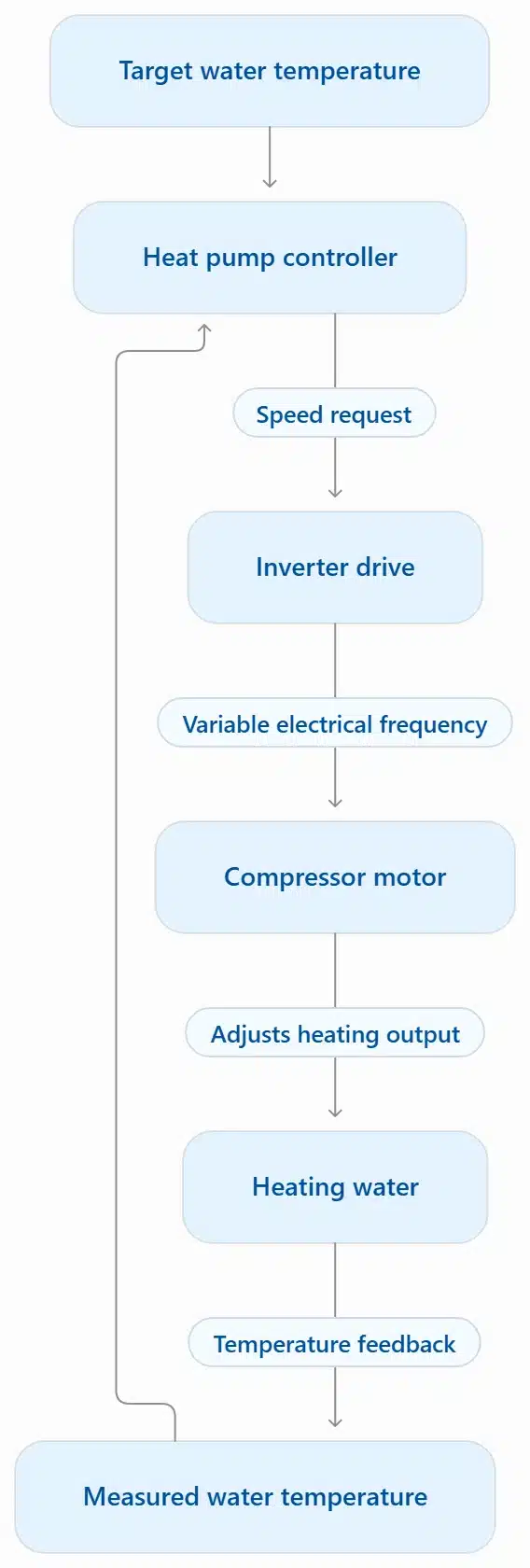
Figure: Temperature feedback allows the controller to adjust compressor speed as heating requirements change. Protective functions can override the requested speed.
The permitted speed range has technical limits. Compressor lubrication, motor operation and the manufacturer’s operating envelope constrain how far the system can reduce or increase output.
How does inverter control compare with fixed-speed operation?
An inverter heat pump adjusts compressor speed within a defined range. A fixed-speed heat pump operates its compressor at one speed and meets lower demand by switching off and on. Both require appropriate sizing, suitable controls, and correct system installation.
The main difference is how the compressor responds when the building needs less heat.
| Comparison | Inverter compressor | Fixed-speed compressor |
|---|---|---|
| Speed while operating | Varies within an approved range | Remains at its operating speed |
| Response to lower demand | Reduces speed until minimum output is reached | Reduces operating time through on/off control |
| Cycling | Can reduce starts and stops while demand remains within its modulation range | Uses starts and stops to regulate average output |
| Temperature control | Supports closer matching between output and demand | Depends on switching controls and system heat storage |
| Selection priority | Match both minimum and maximum output to the building | Match operating capacity and cycling behaviour to the building |
The US Department of Energy identifies capacity matching and reduced on/off operation as advantages of staged and variable-speed heat pump systems.
Fixed compressor speed does not mean identical heating output at every outdoor temperature. Compare both technologies at equivalent heat-source and heating-water conditions.
Inverter operation can also reduce noise at partial load, meaning operation below maximum capacity. That benefit does not establish the noise level at maximum demand; assess the selected model and its installation position.
How much electricity can an inverter heat pump save?
An inverter heat pump can reduce electricity consumption by matching output to demand and limiting cycling losses. The saving depends on the complete installation and comparison system. Seasonal efficiency provides a stronger basis for estimating annual consumption than inverter branding.
There is no defensible universal saving percentage for every inverter heat pump. A comparison needs equivalent heating demand, indoor comfort, weather conditions and equipment boundaries. The inverter’s contribution cannot be isolated by comparing two unrelated installations.
Which efficiency figures matter?
Three measurements answer different performance questions:
| Measurement | Definition | Appropriate use |
|---|---|---|
| COP: coefficient of performance | Heating output divided by electrical input at specified operating conditions | Compare performance at the same test conditions |
| SCOP: seasonal coefficient of performance | Standardised seasonal performance calculated for specified climate and temperature conditions | Compare declared seasonal performance on a consistent basis |
| SPF: seasonal performance factor | Heat delivered divided by electricity consumed over a defined operating period and measurement boundary | Assess installation performance; the annual measure is called Jahresarbeitszahl, or JAZ, in German |
Energieagentur Tirol, a regional Austrian energy advisory organisation, distinguishes measured annual performance from laboratory COP and standardised SCOP values.
For example, A7/W35 identifies an air-source test condition with outdoor air at 7°C and heating-water outlet temperature at 35°C. A COP measured there does not describe performance throughout an Austrian winter.
What does measured performance show?
Fraunhofer ISE, Germany’s Institute for Solar Energy Systems, monitored 77 heat pump systems in existing homes. Its November 2025 findings reported average seasonal performance factors of 3.4 for air-to-water systems and 4.3 for ground-source systems.
These figures describe complete installations in the study. They do not measure the saving attributable to inverter control alone or predict the result for an individual property.
How can you estimate electricity consumption?
Consider a hypothetical installation delivering 18,000 kilowatt-hours (kWh) of heat annually with an SPF of 4:
Annual electricity consumption = 18,000 ÷ 4 = 4,500 kWh.
A kilowatt-hour measures energy. Multiplying the calculated electricity consumption by the applicable electricity price gives the corresponding energy cost.
The calculation must use consistent boundaries. Heat delivery and electricity consumption need to cover the same services and equipment, including any backup heating and circulation equipment included in the performance estimate.
Why does minimum heating output matter when sizing a heat pump?
Minimum heating output determines how low an inverter heat pump can reduce its capacity before cycling becomes necessary. Correct sizing therefore considers both winter peak demand and milder weather, when the building needs less heat but still requires controlled heating.
The modulation range describes the available output between the minimum and maximum under specified conditions. Heating output is measured in kilowatts (kW), a unit of power. It is different from the electrical power consumed.
What happens below the minimum output?
Consider a hypothetical heat pump capable of delivering 2–8 kW at a stated operating condition.
| Building requirement at that condition | Available response |
|---|---|
| 3 kW | The heat pump can modulate within its available range to meet demand |
| 1 kW | The requirement is below its 2 kW minimum, so continuous matching is unavailable |
| 9 kW | The requirement exceeds its 8 kW maximum, so the design needs another way to cover the shortfall |
Below minimum output, the system must manage excess heat through available thermal storage and periods without compressor operation. Inverter control therefore reduces cycling opportunities; it does not eliminate cycling.
A manufacturer’s headline capacity range is not sufficient for sizing. Minimum and maximum output must be checked at the source and water temperatures relevant to the project.
What does the installer need to check?
Request these four items:
- Building heat load: the heating power required at the local winter design temperature.
- Cold-weather capacity: available heating output at that outdoor temperature and the required heating-water temperature.
- Mild-weather minimum output: the lowest available output when space-heating demand falls.
- System operating conditions: the water flow, available system volume and control settings needed for stable operation.
Fraunhofer ISE’s field research identified oversized systems and excessive switching as opportunities for improvement. Modulation remains valuable, but accurate sizing still matters. Fraunhofer ISE
What are the limitations and ownership costs of inverter control?
Inverter control adds power electronics and requires a compatible compressor, drive, and control system. Ownership costs depend on installed price, electricity consumption, maintenance, and repairs. Reduced cycling does not establish a guaranteed lifespan or make every inverter installation economically preferable.
The compressor and inverter must function as a validated combination. Their controls must respect the compressor’s operating limits, including its lubrication requirements.
For an investment comparison, request complete installed quotations and annual electricity estimates based on the same building assumptions. An equipment price alone cannot establish the financial value of modulation.
Service arrangements also belong in the comparison. Ask what the warranty covers, who can diagnose drive faults, and how replacement parts and labour are priced.
Operating settings remain important after installation. The flow temperature is the temperature of water supplied to the heating system. Lower required flow temperatures support heat pump efficiency; inverter control does not remove the effect of temperature requirements.
Which iDM heat pump families can you explore?
iDM Energiesysteme GmbH, an Austrian heat pump manufacturer, offers product families for different buildings and heat sources. Compressor control remains a model-specific attribute. Compare documented modulation ranges and operating conditions before applying a feature or performance claim across a family.
The following examples connect the technology to iDM’s product range without treating every family as technically identical.
| iDM family | Application | Documented example and selection focus |
|---|---|---|
| AERO | Air-source heat pumps, which extract heat from outdoor air | iDM describes the AERO ALM 2–8 as modulating. Compare its capacity data with the building’s winter and mild-weather requirements. |
| TERRA | Heat pumps using ground or groundwater as the heat source | iDM’s product brochure identifies inverter technology for the TERRA SWM range. Check the exact model and source conditions. |
| iPUMP | Heat pump packages incorporating domestic-hot-water storage on relevant models | The iPUMP A8 ONE technical table explicitly lists inverter control. Assess space heating and hot-water requirements together. |
| MAX | Larger heat pump systems for buildings such as residential complexes and commercial properties | iDM describes the AERO ALM 10–50 MAX as modulating. Its capacity-control arrangement requires project-specific assessment. |
| NANO | Decentralised heat pump solutions serving individual apartments | The iPUMP N5 serves apartment heating and hot-water applications. Selection starts with the dwelling’s demand and the proposed shared heat-source arrangement. |
Family names describe applications, heat sources or packaging. The selected model’s technical documentation establishes its compressor control, usable output range and performance.
What are the frequently asked questions about inverter compressors?
Inverter control identifies how a heat pump adjusts compressor speed. It does not specify the compressor’s mechanical design, establish compatibility with replacement electronics, or determine storage requirements. Those questions require separate checks against the manufacturer’s documentation for the complete installation.
Is an inverter compressor the same as a scroll compressor?
No. “Inverter” describes electronic speed control; “scroll” describes a mechanical compressor design. Both scroll and rotary compressor designs are available with inverter drives. The terms describe different attributes of the compressor.
Can an inverter be added to an existing fixed-speed heat pump?
Adding a drive requires an approved compressor-and-control combination. Compatibility includes the motor, operating range and protective functions. Ask the heat pump manufacturer about supported options before treating an inverter as a standalone upgrade.
Does an inverter heat pump eliminate the need for a buffer tank?
No automatic conclusion follows from inverter control alone. A buffer tank stores heating-system water. Its need depends on the installation’s water volume, circuit arrangement and control strategy, together with the manufacturer’s requirements.
How can you choose the right inverter heat pump?
Choose an inverter heat pump by matching its usable output range to your building’s heating requirements. Ask for seasonal performance estimates, capacity at local winter conditions, and documented minimum output. These checks turn compressor technology into a meaningful purchasing decision.
Bring your building’s heating information, current system details and hot-water requirements to an iDM consultation. The resulting assessment can identify the appropriate product family and model for your project.