What Are Heat Pump Refrigerants? Types, Safety and Examples
Heat pump refrigerants are working fluids that absorb and release heat inside a heat pump’s closed circuit. A heat pump uses energy to transfer heat from a cooler source to a warmer destination. Its refrigerant enables this process through changes in pressure, temperature and physical state between liquid and vapour.
The refrigerant affects the equipment’s design, safety requirements and potential climate impact from leakage. Understanding these differences helps you assess a heat pump proposal, although the refrigerant name alone cannot predict your heating bills.




How is refrigerant different from heating water and brine?
Refrigerant carries energy inside the heat pump’s sealed circuit. Heating water distributes that energy through the building. Brine, a water and antifreeze mixture, collects ground heat in suitable systems. Heat exchangers transfer energy between these fluids without mixing them together.
A heat exchanger is a device that transfers heat between separate fluids. In a water-based heat pump heating system, the refrigerant remains separate from the water flowing through radiators or underfloor heating. In a brine-to-water installation, the ground collector also has its own fluid circuit.
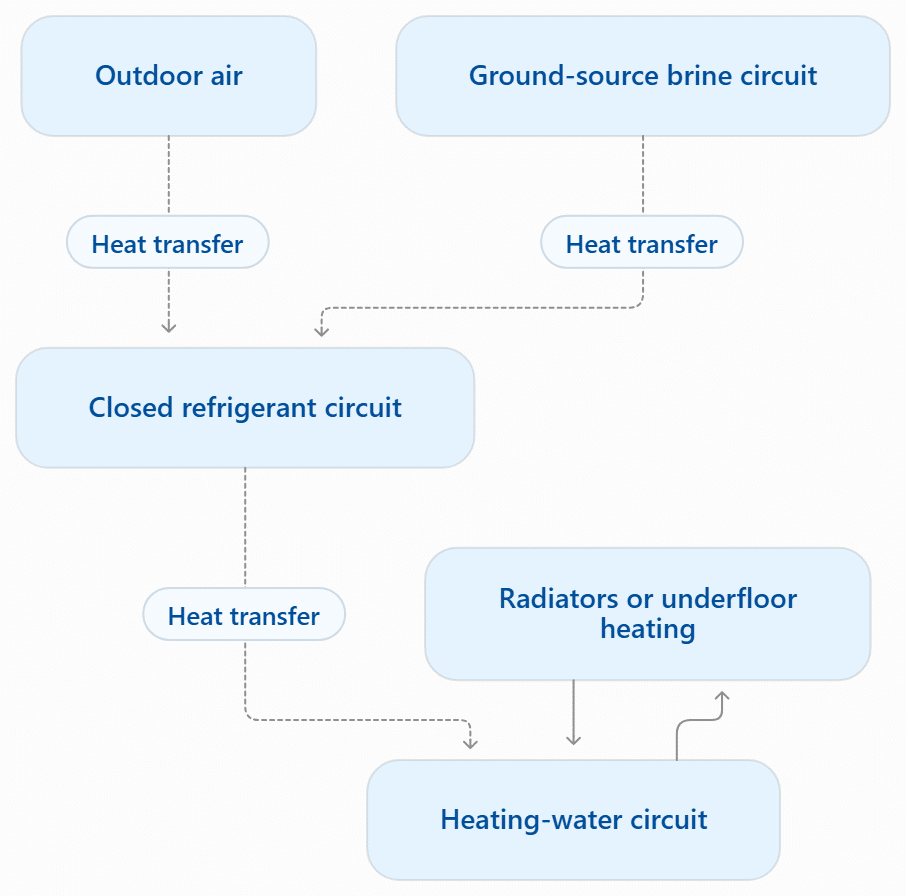
Simplified heating-mode diagram. Air and brine represent alternative heat sources. Dotted arrows show energy transfer through heat exchangers; solid arrows show heating-water circulation.
The refrigerant also remains separate from domestic hot water—the drinking water supplied to taps and showers. Adding water to a heating circuit does not replenish refrigerant.
Which refrigerants are used in heat pumps?
Heat pumps use refrigerants including R290, R32, R410A and R513A. These substances differ in composition, flammability and climate impact. A refrigerant’s designation identifies the fluid; it does not state the heat pump’s efficiency or prove suitability for a particular building.
R290 is propane, a hydrocarbon consisting of carbon and hydrogen. It belongs to the natural refrigerant category because the substance occurs in natural material cycles. Refrigerant-grade propane is processed for technical use; “natural” does not mean unprocessed or harmless.
Hydrofluorocarbons, abbreviated HFCs, are synthetic fluorinated compounds used as refrigerants. Hydrofluoroolefins, abbreviated HFOs, are fluorinated compounds containing a carbon–carbon double bond. Refrigerants can consist of one substance or a blend of substances.
Global warming potential, or GWP, compares the warming effect of releasing a substance with that of releasing the same mass of carbon dioxide, CO₂. The figures below use a 100-year comparison period.
| Refrigerant | Substance or family | GWP over 100 years* | Flammability classification |
|---|---|---|---|
| R290 | Propane; natural hydrocarbon | 0.02 | Highly flammable |
| R32 | Single-substance HFC | 675 | Lower flammability with low burning velocity |
| R410A | HFC blend | 2,088 | No flame propagation under standard test conditions |
| R513A | HFC/HFO blend | 629 | No flame propagation under standard test conditions |
GWP figures follow the current EU regulatory basis reported by the European Commission and Germany’s Environment Agency. Flammability descriptions follow refrigerant safety classifications. These are fluid properties, not equipment performance ratings.
R290 heat pumps circulate propane as a working fluid. They do not burn propane to produce heat.
How does the refrigerant affect climate impact and efficiency?
A heat pump’s environmental performance depends on refrigerant leakage and electricity use. Lower refrigerant global warming potential reduces the climate impact of escaped fluid. Efficient operation reduces electricity demand. Evaluate both factors when comparing complete heat pump systems for installation.
Refrigerant quantity determines the potential impact of a leak
The refrigerant charge is the mass of refrigerant contained in the system. GWP and charge answer different questions: GWP describes the substance, while charge describes the quantity present.
The climate impact associated with a release is calculated as:
Refrigerant released in kilograms × GWP = kilograms of CO₂ equivalent
CO₂ equivalent, written CO₂e, expresses the warming effect using an equivalent quantity of carbon dioxide.
For a hypothetical release of 0.5 kg of R410A, the calculation is:
0.5 × 2,088 = 1,044 kg CO₂e
This illustrates a specified release. It does not imply that a heat pump releases its entire charge, or any fixed percentage, each year.
Efficiency belongs to the complete heat pump
The coefficient of performance, or COP, compares useful heat output with electrical input at stated operating conditions. The seasonal coefficient of performance, or SCOP, expresses performance across a standardised heating season.
Energieagentur Tirol, a regional Austrian energy agency, explains that a heat pump can supply three to four units of heating energy for one unit of electricity. This is an explanatory guide to heat pump performance, not a guaranteed result for every building or refrigerant.
For a specific iDM example, the iPUMP T7 ONE uses R290 and has a declared SCOP of 4.85 at 35°C for the average climate in iDM’s catalogue. That rating describes the complete product under the stated conditions. It is not an efficiency value belonging to R290 itself.
Compare proposed heat pumps at equivalent source temperatures, heating-water temperatures and climate conditions. A lower refrigerant GWP does not automatically establish lower electricity consumption.
Are heat pump refrigerants safe?
Heat pump refrigerants require safety measures matched to their flammability, pressure and charge. R290 is highly flammable, while R32 has lower flammability. Safe installation depends on equipment design, location and professional servicing, including the manufacturer’s requirements for each specific model.
Refrigerant safety classes combine toxicity and flammability. Under the classification described by ASHRAE, the engineering society that develops refrigerant standards, A denotes lower toxicity. A1 indicates no flame propagation in the prescribed test, A2L indicates lower flammability and low burning velocity, and A3 indicates high flammability. Lower toxicity does not mean that an uncontrolled release is harmless.
For an R290 installation, the contractor must assess the specified protection area around the equipment. Depending on the model and location, relevant features include building openings, drains, depressions and ignition sources. Use the installation manual’s requirements for the selected unit; a universal clearance distance is not appropriate.
Refrigerant-grade propane is odourless. Smell is therefore not a reliable way to identify an R290 leak. Suspected leakage requires the manufacturer’s safety procedure and qualified service support.
Which refrigerants do iDM heat pumps use?
iDM Energiesysteme GmbH, an Austrian heat pump manufacturer, uses different refrigerants across its ranges. Examples include R290 and R513A. The model, generation and documentation determine the refrigerant specification; a family name alone does not establish which working fluid is used.
The following examples connect refrigerant specifications with identifiable iDM products.
| iDM range and application | Specific product example | Documented refrigerant |
|---|---|---|
| AERO: air-source heat pumps | AERO ALM 2-8 | R290 |
| TERRA / MAX: ground or groundwater heat pumps for larger heating demands | TERRA SW 50 MAX H 513 | R513A. (90 kW (R513A) 35 kW) |
| iPUMP: heat pumps with integrated domestic-hot-water storage in the ONE models | iPUMP T7 ONE | R290 |
| MAX: heat pumps for larger buildings | AERO ALM 10-50 MAX | R290 |
| NANO: decentralised apartment heat pumps | iPUMP N5 | R290 |
These examples are not a specification for every product in each range. Check the full model designation, the applicable technical document and local availability when requesting a quotation.
For an existing installation, use the equipment label and its original documentation. A current product with a similar family name does not establish the refrigerant used in an earlier unit.
What do refrigerant rules mean in Austria and DACH?
Austria and Germany apply the European Union’s F-gas Regulation, which restricts fluorinated refrigerants in defined equipment categories. Switzerland applies separate national rules. Upcoming deadlines concern specified products entering the market; they do not automatically require replacement of existing heat pumps.
The EU’s F-gas Regulation, Regulation (EU) 2024/573, governs fluorinated greenhouse gases and equipment using them. It combines supply restrictions with requirements covering equipment, leakage prevention, servicing and recovery. It has applied since 11 March 2024.
Equipment classification matters. A self-contained heat pump has no refrigerant-containing parts connected on site. A split system connects separate units through refrigerant pipework. The presence of both indoor and outdoor equipment alone does not establish the legal category.
Selected restrictions on placing heat pumps on the EU market are:
| Date | Equipment category | Main restriction |
|---|---|---|
| 1 January 2027 | Self-contained heat pumps up to and including 50 kW | Fluorinated refrigerants with GWP of 150 or more |
| 1 January 2027 | Split air-to-water systems up to and including 12 kW | Fluorinated refrigerants with GWP of 150 or more |
| 1 January 2032 | Self-contained heat pumps up to and including 12 kW | Fluorinated refrigerants |
| 1 January 2035 | Split systems up to and including 12 kW | Fluorinated refrigerants |
These entries are subject to the regulation’s specified safety exceptions. Different deadlines apply to other equipment categories and capacities. Have the supplier confirm the classification and applicable requirements for the proposed system.
For owners of existing heat pumps, a restriction on new equipment entering the market is not an automatic operating ban. Servicing requirements and refrigerant availability must be assessed separately.
Switzerland regulates refrigerants through Annex 2.10 of its Chemical Risk Reduction Ordinance, known as ChemRRV in German. The Swiss Federal Office for the Environment publishes the applicable requirements, including changes taking effect on 1 January 2027. EU deadlines must not be applied to Swiss projects without checking Swiss law.
How do you choose a heat pump with the right refrigerant?
Choose a heat pump by matching its refrigerant, installation requirements and verified performance to your building. Request the exact refrigerant designation, charge and service arrangements in the quotation. A low GWP value supports selection, but cannot establish suitability by itself.
Ask the supplier to document four points:
- Refrigerant specification: Record the exact model, refrigerant designation and installed charge.
- Installation suitability: Confirm the approved location, required protection areas and any indoor installation conditions.
- Comparable performance: Request efficiency and heating-output data at conditions relevant to the building.
- Service and regulatory position: Confirm qualified local support, applicable inspection duties and the equipment’s market eligibility.
For homeowners, these checks make proposals easier to compare. For facility managers and contractors, they also support maintenance planning and equipment records.
Request an itemised installed-system quotation. Refrigerant price alone does not represent the cost of equipment, safety provisions, commissioning, electricity or future repairs. No fixed saving can be attributed to a refrigerant name without comparing the complete proposed systems.
What other questions do heat pump owners ask about refrigerants?
Heat pump owners need to know how to identify their refrigerant, whether refilling is necessary and who can service the circuit. The equipment label and model documentation provide the starting point. Refrigerant changes and suspected leaks require qualified professional assessment.
Where can I find my heat pump’s refrigerant type?
Check the identification label and installation documentation for the refrigerant code and charge. Record the full model and serial number when contacting service support. Avoid identifying the fluid from appearance, product family or installation year alone.
Does refrigerant need regular topping up?
Refrigerant circulates in a closed circuit and is not consumed as heating fuel. Routine operation does not require scheduled topping up. A loss of charge needs professional investigation and correction before the appropriate refrigerant quantity is restored.
Can an R410A heat pump be refilled with R290?
No simple refill conversion is appropriate. A heat pump designed for R410A cannot automatically accommodate propane’s flammability or its different operating requirements. Any conversion requires an explicitly approved engineering solution; replacing the fluid without that approval is unsafe.
Does every heat pump require an annual refrigerant leak check?
No. Statutory inspection duties depend on the refrigerant, quantity, equipment classification and applicable exemptions. Manufacturer maintenance requirements also apply. Ask the installer to record the inspection obligations for the specific installation at handover.
A suitable refrigerant is one part of a suitable heat pump. Bring the model specification, installation conditions and expected performance together before deciding.
Explore the relevant iDM product and configure a solution for your home and discuss the refrigerant specification with an iDM specialist.